
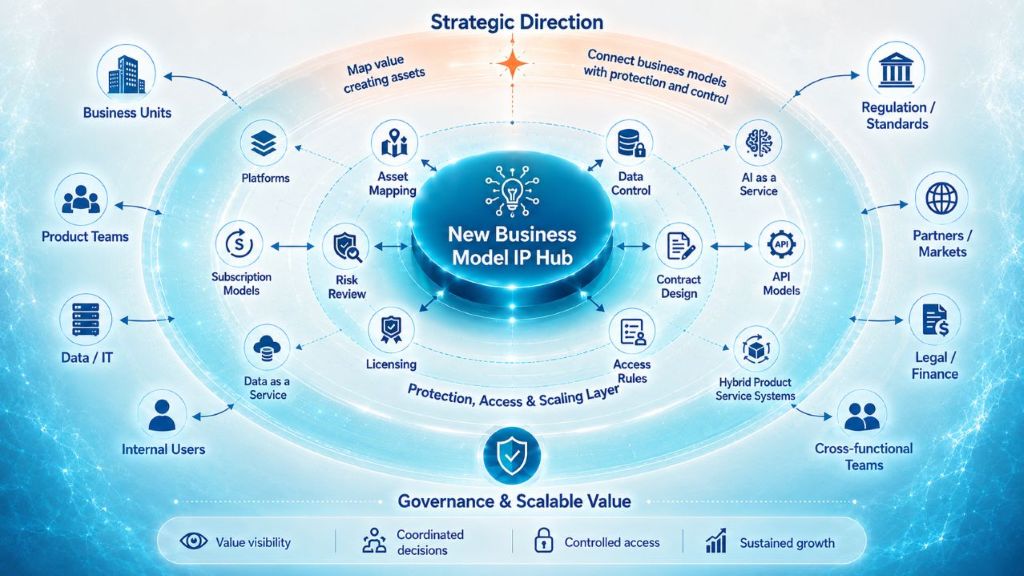
New business models change where value is created, how value is accessed and which intangible assets become strategically relevant. Platforms, subscription models, Data as a Service, AI as a Service, API based access models and hybrid product service systems all rely on combinations of technology, data, software, customer relationships, contracts, interfaces, operational knowledge and ecosystem participation. This creates a demanding IP management👉 Strategic and operative handling of IP to maximize value. challenge because the protection logic must follow the business model👉 A business model outlines how a company creates, delivers, and captures value. before the model is scaled.

This Deep Dive points to the upcoming OFB Fireside Chat on IP Related Issues Regarding New Business Models. The discussion will address why new digital and service oriented business models require a clear IP control architecture that connects formal IP rights, data control, contractual design, access management, trade secret👉 Protects confidential business info for competitive advantage. protection, licensing logic and partner governance.
Business model innovation as an IP management challenge
Business model innovation👉 Practical application of new ideas to create value. often begins with a commercial observation. Customers may prefer access over ownership, continuous service over one time purchase, data based insight over hardware functionality, or integrated solutions over standalone products. Digital technologies then make new forms of delivery possible, from cloud based software and connected devices to API ecosystems, AI enabled services and platform based coordination between market participants.
This commercial logic changes the role of IP management. In a traditional product business, IP management could often begin with identifiable objects such as inventions👉 A novel method, process or product that is original and useful., product names, product designs, software code or confidential manufacturing processes. In digital business models, the value frequently emerges from a system of assets that work together. A technical function, a dataset, an interface, a workflow, a user relationship, a brand👉 A distinctive identity that differentiates a product, service, or entity. promise, a licensing structure and a set of contractual access rules may jointly determine whether the model can be protected and monetized.
The central IP management question therefore concerns the architecture of control. Companies need to understand which assets create the economic advantage, which actors may access them, which rights must be secured, which information must remain confidential, which use cases require licensing👉 Permission to use a right or asset granted by its owner. and which contractual terms must mirror the technical and commercial design of the model. This requires IP management to be involved when the business model is designed, priced, contracted and scaled.

Related reading: The 📑IP Management Letter on IP Strategy👉 Approach to manage, protect, and leverage IP assets. as a Functional Strategy is useful at this point because it explains why IP strategy must be aligned with broader business objectives, cross functional collaboration and strategic decision making👉 The process of choosing the best option among alternatives.. This provides a conceptual basis for treating IP as part of business model design.
👉 https://profwurzer.com/ip-strategy-is-a-functional-strategy/
The new business models that change the IP asset structure
Platforms are one of the clearest examples of a changed asset structure. A platform creates value by enabling interactions between users, suppliers, developers, customers or other participants. The relevant IP assets include software, interface documentation, data structures, algorithms, brand trust, participation rules, user generated content, access conditions and governance mechanisms. The platform operator’s strategic position often depends on the ability to define who may participate, how data flows, what complementary services can be built and how conflicts between participants are managed.
Subscription models create a different IP challenge because value is realized over time. The company must provide continuous access, updates, improvements, service levels and user experience. This makes software, release cycles, data use, customer analytics, service documentation, technical support routines and contractual renewal logic strategically relevant. IP management must support the stability of recurring revenue by clarifying what customers receive, what they may use, what remains controlled by the provider and how improvements are handled.
Data as a Service models place data origin, data quality, data processing, aggregation, permitted use, anonymization, exclusivity, portability and onward transfer at the center of the business model. The decisive assets may include curated datasets, data pipelines, metadata structures, validation methods, data cleaning know how, access interfaces and customer specific insight layers. Formal IP rights may support parts of the model, while contractual permissions and data governance often determine whether the service can be lawfully and commercially scaled.
AI as a Service models add further complexity because value may be distributed across models, training data, domain expertise, prompts, evaluation routines, feedback loops, deployment environments and performance monitoring. The rights position around customer inputs, generated outputs, model improvement, benchmarking, confidentiality and reuse becomes central to the commercial model. A company that sells AI enabled functionality must understand how the system learns, what information it uses and how improvements are allocated between provider and customer.
API based business models treat technical access as a commercial asset. The interface enables third parties to connect, build, automate or integrate. The strategic value depends on documentation, reliability, authentication, usage rules, pricing models, restrictions, termination rights and the ability to change the interface without undermining customer trust. IP management must therefore connect the legal terms of access with the technical architecture of the API.
Hybrid product service systems combine physical products with software, sensors, usage data, maintenance logic, analytics and long term customer relationships. A machine, medical device, vehicle component, industrial tool or energy system can become the physical entry point into a service model. The relevant assets include embedded software, control logic, diagnostic data, predictive maintenance knowledge, digital twins, spare parts information, performance histories and lifecycle contracts.
Related reading: The Deep Dive on AI in Operational IP Management is useful where AI based services, internal AI tools or AI supported workflows become part of the business model. It explains how AI changes IP work through data access, confidentiality, human responsibility, contracts, FTO preparation and governance.
👉 https://profwurzer.com/diplex/docs/ip-and-organization/ai-in-operational-ip-management/
Identifying the IP assets that carry the real value
A digital business model can contain many protectable and controllable assets, although only some of them will be visible in a conventional IP register. Patents may protect technical effects in connected devices, AI related technical implementations, sensor systems, data processing methods, control systems or industrial automation. Trademarks may protect the market identity of a platform, service or ecosystem. Design rights may protect visual interface elements or product service touchpoints. Copyright👉 A legal protection for original works, granting creators exclusive rights. may protect software, documentation, databases in selected legal contexts and creative content.
These rights remain important because they create identifiable legal positions. They can support exclusivity, licensing, enforcement, negotiation power, investor confidence and market differentiation. They also provide a language that external parties understand when assessing the company’s intangible asset👉 An intangible asset is a non-physical resource with economic value to a company. base.
The economic value of new business models frequently depends on assets that require additional management attention. These include data structures, access rights, model evaluation methods, configuration knowledge, onboarding routines, customer specific adaptations, internal documentation, usage analytics, performance histories, compliance evidence, process know how, interface rules and ecosystem governance mechanisms. Such assets may be decisive for value creation even when they cannot be captured through a single formal IP right.
This makes asset mapping a core IP management task. Companies need to identify which assets support revenue generation, which assets enable customer retention, which assets create barriers to imitation, which assets create partner dependency and which assets become critical during scaling. This mapping should connect technical, legal and commercial perspectives because the same asset can have different strategic meanings depending on the revenue model.
For example, customer usage data may be a learning asset for an AI service, a performance evidence asset for a subscription model, a compliance risk👉 The probability of adverse outcomes due to uncertainty in future events. in a regulated setting and a negotiation point in a partner contract. Interface documentation may be an operational necessity, a developer enablement tool, a trade secret risk and a potential source of ecosystem control. A model evaluation method may be a quality assurance tool, a competitive differentiator and a sensitive know how asset.
From protection rights to control architecture
Classical IP protection provides a crucial foundation for many digital business models. Patents, trademarks, designs, copyright and trade secrets help companies define boundaries, secure exclusivity, defend market positions and create negotiation leverage. A business model that ignores these rights can become exposed to imitation, dependency and weak bargaining power.
Digital value creation also requires control mechanisms that operate beyond formal registration. Data control determines who may collect, process, combine, store, access, train on and monetize data. Contractual architecture determines ownership, use rights, improvement rights, sublicensing, confidentiality, audit rights, termination consequences and post contract restrictions. Technical access control determines who can use a platform, connect to an API, access a dataset, deploy a model or integrate a service.
Trade secret protection becomes particularly important where value lies in configurations, data processing methods, internal workflows, system tuning, evaluation routines, commercial rules, supplier knowledge or customer specific implementation experience. Trade secret protection requires more than calling information confidential. It depends on classification, access controls, documentation, contractual safeguards, employee awareness, supplier governance and evidence that reasonable protective measures were applied.
The key management task is to combine these elements into a coherent control architecture. A patent👉 A legal right granting exclusive control over an invention for a limited time. may protect a technical function, while contractual terms regulate access to the service. A trademark👉 A distinctive sign identifying goods or services from a specific source. may create trust, while data governance defines permitted use. Copyright may protect code, while technical controls prevent unauthorized copying or integration. Trade secrets may protect internal processes, while partner agreements allocate improvements and restrict further disclosure.
A fragmented approach creates weak points. The company may have strong patents but weak customer terms. It may have strong software copyright but unclear open source governance. It may have valuable data but insufficient rights to reuse it. It may have attractive platform technology but partner contracts that undermine strategic control over future improvements.
Related reading: Operational IP Management for Industrial Practice provides the broader organizational frame for this issue. It shows why IP must be embedded in product development, business processes and cross functional decision making when companies manage intangible assets in practice.
👉 https://profwurzer.com/diplex/docs/operational-ip-management/
How revenue models change licensing, access and contract design
Revenue models determine which IP questions become operationally important. A one time product sale mainly requires clarity on product related rights, manufacturing freedom, market access, branding and sales contracts. A subscription model requires rules for continuous access, updates, customer data, account management, service availability, termination effects and restrictions on use. The contractual relationship becomes part of the product experience because the customer pays for ongoing value.
Data as a Service models require precise rules on data provenance, quality, aggregation, permitted fields of use, onward transfer, sublicensing, customer derived data and analytics reuse. The contract must describe what the customer receives and what remains controlled by the provider. It must also address liability for data errors, regulatory restrictions, data security, auditability and the consequences of combining provider data with customer or third party data.
AI as a Service models require additional rules for inputs, outputs, training, fine tuning, model improvement, confidentiality, benchmarking and responsibility for downstream decisions. The customer may expect rights to use outputs, while the provider may need rights to learn from interactions. The contract must allocate these interests in a way that supports the service model, protects sensitive information and avoids uncontrolled transfer of strategic learning.
API models require access governance as a central licensing mechanism. The company must define who may connect, which technical uses are allowed, how usage is measured, how pricing is calculated, what happens in case of misuse and how changes to the interface are communicated. Access terms, developer terms, service level commitments and technical documentation together define the commercial reality of the API.
Hybrid product service systems require a lifecycle contract logic. The company may sell or lease a product, provide updates, collect operational data, perform remote diagnostics, offer predictive maintenance, supply analytics and use field data for future improvements. Each layer raises questions about data rights, software rights, spare parts information, maintenance knowledge, customer confidentiality, service obligations, liability and improvement allocation.
Licensing in this context becomes a management capability. It must connect IP assets, revenue logic, customer promises, partner access, compliance requirements and operational follow up. A license that looks acceptable in legal terms can still fail commercially if reporting, data capture, usage measurement or access control cannot be operated.
Related reading: The OFB Fireside Chat documentation on licensing explains why licensing value is created through strategic alignment, governance and post deal realization. It is directly relevant where new business models depend on controlled access to intangible assets.
👉 https://ipbusinessacademy.org/licensing-beyond-deals-where-value-is-really-created
Partner ecosystems and the allocation of future value
Many new business models grow through partners. Platforms need participants, developers, complementors, suppliers, data providers, integrators or distributors. AI services may depend on cloud infrastructure, specialist datasets, model providers, system integrators or domain experts. Hybrid product service systems may involve hardware suppliers, software vendors, maintenance partners, customers and analytics providers.
This creates a complex allocation problem. Each partner may contribute background IP, data, know how, software, customer access or operational capability. The cooperation may generate new results, improvements, configurations, data insights, documentation, models, interfaces, workflows or market knowledge. The commercial success of the model often depends on whether these contributions and outputs are clearly allocated before value emerges.
Partner contracts should therefore address background IP, new results, improvement rights, data use, confidentiality, publication, sublicensing, exclusivity, customer specific developments, access to documentation, audit rights and exit scenarios. They should also define what happens when the partnership ends, when the business model expands into another market, when a partner is acquired or when the technology architecture changes.
The difficulty increases when the company wants to build an ecosystem. Broad access can support adoption, network effects and market penetration. Excessive openness can weaken control over critical assets, customer relationships and future monetization. Restricted access can preserve control, while limiting ecosystem growth. IP management must help the company define where openness creates strategic value and where tighter control is required.
The allocation of future value deserves special attention. Improvements often arise during implementation, customer interaction and operational use. A partner may improve an integration layer. A customer may shape a configuration. A supplier may develop a better technical component. An AI service may improve through accumulated use. These improvements can become more valuable than the initial asset, especially when the business model scales.
Scaling risks when the control logic remains unclear
Early stage experimentation often hides IP weaknesses. A pilot project may operate with a small customer group, bespoke agreements, manual processes and informal coordination between trusted people. The technical concept can look convincing, customer feedback can be positive and management can see market potential. The underlying rights and control logic may remain underdeveloped because the immediate commercial pressure is to prove the model.
Scaling changes the situation. Standard terms must work across many customers. Data rights must be consistent across use cases and jurisdictions. Software components must be traceable. API access must be governed systematically. Customer specific adaptations begin to overlap with reusable platform assets. Partner roles multiply. Investors, acquirers, auditors and strategic customers begin to ask whether the company actually controls the assets on which the model depends.
Unclear control logic can then create concrete business risks. The company may lack the right to use customer data for service improvement. It may have promised exclusivity too broadly in early customer contracts. It may be unable to reuse developments from one project in another. It may discover open source obligations late. It may depend on a supplier that controls a critical interface. It may have no reliable evidence for trade secret protection. It may face uncertainty about ownership of AI generated outputs or model improvements.
These risks affect valuation, financeability, transaction readiness and strategic freedom. A business model that depends on unclear data rights, weak access terms or unresolved partner dependencies may look attractive in revenue forecasts while remaining fragile in due diligence. The more successful the model becomes, the more visible these weaknesses can become to competitors, customers, partners and investors.
Scaling therefore requires an IP control review before the model is broadly deployed. This review should examine asset ownership, access points, data flows, software components, open source exposure, customer terms, partner contracts, improvement rights, confidentiality measures, licensing obligations, enforcement options and operational responsibilities.
Related reading: Controlling License Contract Compliance is useful where digital business models depend on continuing access, reporting, usage restrictions and contractual obligations. It explains why licensing agreements require monitoring, interpretation and operational controls after signature.
👉 https://profwurzer.com/diplex/docs/controlling-license-contract-compliance/
IP management as a design function for digital transformation
IP management must move closer to business model design in digital transformation👉 Using digital technology to redesign processes, culture, and value creation now.. The relevant decisions arise before contracts are finalized and before market launch. They arise when the company defines how customers access a service, how data is collected, how software is deployed, how partners connect, how updates are provided, how pricing is measured and how improvements are reused.
This requires an integrated working model. IP management should work with digital strategy, product management, R&D, data governance, legal, compliance, IT security, finance, sales and business development. Each function sees part of the business model. IP management provides the connective layer that translates intangible assets into protection, access rules, licensing options and control points.
The conversation should begin with the value logic of the model. Companies should ask where the customer perceives value, which assets make the model hard to copy, which rights are needed for market entry, which data can be used, which partners must be involved, which dependencies are acceptable and which protection mechanisms support future growth. These questions help prevent IP management from becoming a late stage risk check.
A mature approach creates a living control map for the business model. This map connects assets, rights, data flows, contracts, access rules, confidentiality measures, responsibilities and escalation points. It should be updated as the model evolves, especially when the company enters new markets, adds partners, changes pricing, launches new service layers, integrates AI or moves from bespoke projects to standardized offerings.
Related reading: Turning IP into Value – Smart Licensing Models is helpful where companies need to connect IP assets with monetization, valuation, compliance and global regulation. The article supports the idea that licensing structures must fit the business model and remain manageable in practice.
👉 https://profwurzer.com/diplex/docs/smart-licensing-models/
What companies need to do
Companies developing new digital and service oriented business models need to treat IP management as part of business model architecture. They should identify which assets carry value, how those assets interact and which control mechanisms are needed before the model is scaled.
A practical management approach should cover five areas:
- Map the business model and its intangible assets. This includes formal IP rights, software, data, interfaces, models, workflows, documentation, know how, brand trust, partner access and customer relationships.
- Define the control architecture. This includes patents, trademarks, designs, copyright, trade secrets, data governance, contractual terms, technical access control, confidentiality measures and operational responsibilities.
- Align revenue logic with contract and licensing design. Subscription models, Data as a Service, AI as a Service, API models and hybrid product service systems each require different rules for access, use, improvement, termination, reporting and partner participation.
- Clarify partner and customer positions early. Background IP, new results, data use, improvement rights, customer specific adaptations, sublicensing, exclusivity and exit scenarios should be resolved before dependencies become commercially significant.
- Review scaling readiness before broad deployment. Companies should test whether the model can be standardized, financed, licensed, defended and audited with the existing IP, data and contract structure.
The strategic task is to make digital value creation controllable. Companies that understand the asset structure of their new business models can protect what matters, allocate rights with greater precision, design stronger licensing and access models, reduce scaling risks and build more reliable foundations for growth in the digital transformation.