
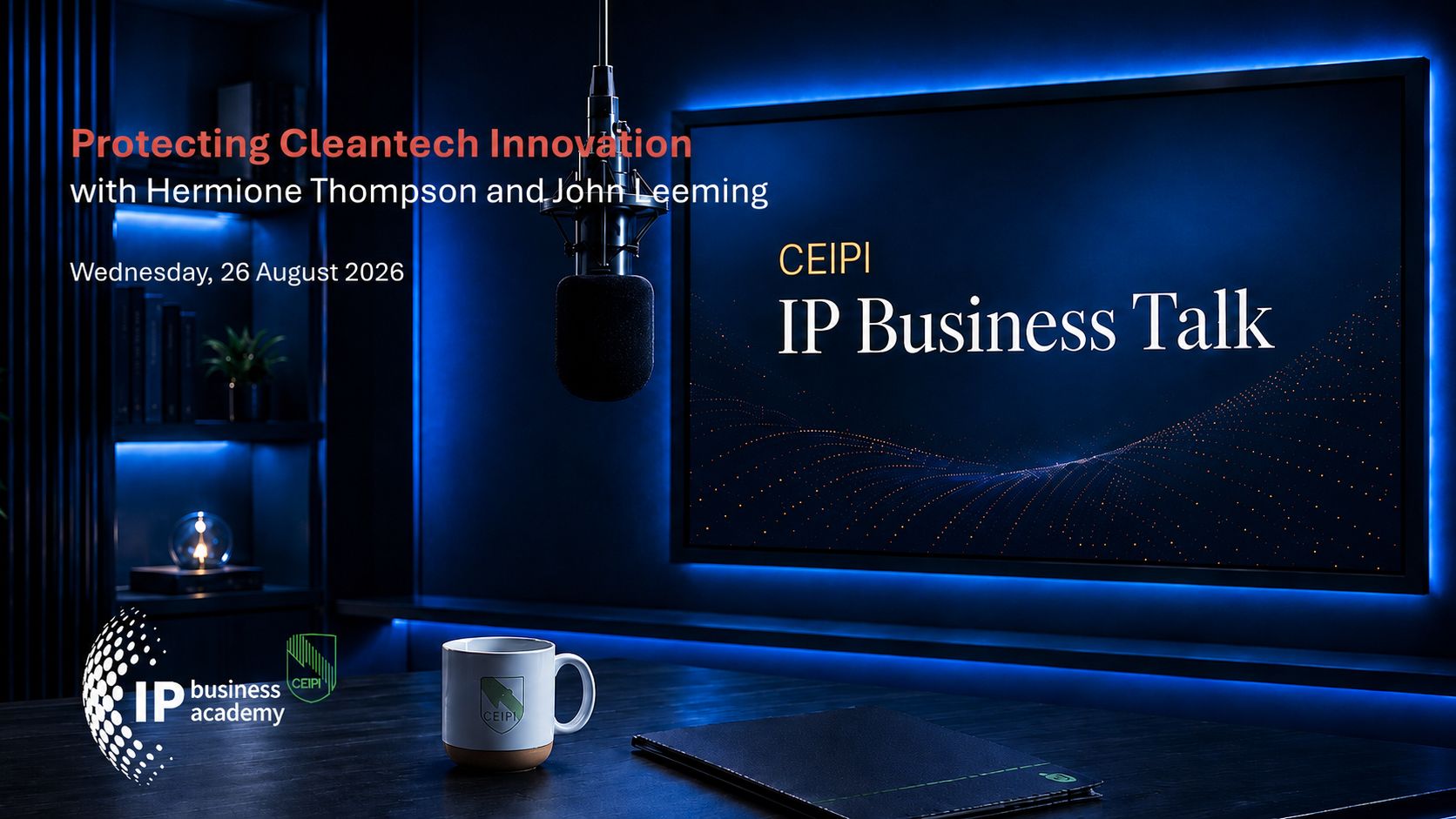
The CEIPI IP Business Talk with Hermione Thompson and John Leeming explored how cleantech companies can build patent👉 A legal right granting exclusive control over an invention for a limited time. portfolios while technologies, production systems, markets and financing requirements continue to evolve. The discussion showed that cleantech IP reaches far beyond the patentability of an individual invention. It involves multidisciplinary invention harvesting, filing geography, freedom to operate👉 Strategic analysis to determine whether a product or service might infringe existing IP rights., investor expectations, manufacturing know-how, portfolio architecture and the timing of decisions throughout the scale-up process.
The GreenTech IP Expert Contributors, Dr. Friedrich Linhart and Russell Woolley, brought these issues into the practical reality of technology companies. Their contributions focused on the particular demands of GreenTech, the influence of climate change on filing strategies, the credibility created by a systematic FTO process, the changing importance of IP across a startup’s financing trajectory and the role of manufacturing process patents in mature portfolios.
Key message
Cleantech patent strategy must develop with the technology and the company. A credible portfolio connects multidisciplinary invention capture, commercially relevant filing decisions, ongoing FTO work and protection across products, processes and systems with the milestones of scaling, investment and market entry.
Replay the IP Business Talk of Wednesday, 26 August 2026
Guest
- Hermione Thompson, Partner, European Patent Attorney, UK Patent Attorney and UPC Representative at J A Kemp
- John Leeming, Partner, European Patent Attorney, UK Patent Attorney, Patent Attorney Litigator and UPC Representative at J A Kemp
GreenTech IP Expert Contributors
- Dr. Friedrich Linhart, European, German and Swiss Patent Attorney and European Trademark👉 A distinctive sign identifying goods or services from a specific source. and Design Attorney at Linhart Intellectual Property👉 Creations of the mind protected by legal rights.
- Russell Woolley, Partner and Patent Attorney at Carpmaels & Ransford, specialising in energy storage and conversion technologies
The CEIPI IP Business Talk with Hermione Thompson and John Leeming addressed a practical question for cleantech companies: how can patent protection remain relevant while a technology moves from research and prototypes through industrialisation, financing and market deployment?
This challenge is particularly demanding in GreenTech because the protected value rarely sits in one technical layer. A clean-energy product may combine materials, mechanical engineering, electronics, software, control systems, manufacturing methods and environmental performance. The commercially important invention may lie in a component, in the interaction between components, in a production step or in the operation of the complete system. At the same time, partnerships, grants, pilot projects, technical publications and investor discussions create pressure to make IP decisions while the technology is still changing.
Hermione Thompson and John Leeming therefore framed patent strategy as a continuing business process. Invention capture, filing, prosecution, FTO, confidentiality and portfolio review all need to follow the company’s development path. The contributions from Dr. Friedrich Linhart and Russell Woolley made this dynamic especially clear by connecting the discussion to the decisions that GreenTech startups and scale-ups face in practice.
GreenTech invention harvesting requires multidisciplinary interpretation
Dr. Friedrich Linhart first challenged the panel to define what is genuinely distinctive about IP harvesting and protection in GreenTech. Many of the principles discussed in the talk, such as educating engineers, creating invention disclosure channels and involving business decision-makers, apply across industries. His question therefore went to the sector-specific layer: what additional difficulty arises when a GreenTech invention combines several technologies, and how important is it to involve people who understand all of them?
This contribution identified one of the structural problems of cleantech IP. A development team may see separate engineering tasks where the company should see one commercially relevant invention. A materials specialist may focus on composition, a mechanical engineer on architecture, a software team on control logic and a production engineer on yield or throughput. The patentable and commercially defensible contribution may emerge only when these perspectives are considered together.
Thompson emphasised that engineers and researchers should be able to recognise developments that may matter, without being expected to decide patentability themselves. Their role is to report technically or economically relevant changes. The legal and business assessment can then determine whether the development should be patented, kept confidential, documented as know-how or left unprotected. This division of responsibility is especially useful in multidisciplinary GreenTech projects, where an apparently incremental change in one technical field can alter the value of the whole system.
The discussion also showed why invention harvesting must continue after an initial patent filing. Scale-up frequently creates new technical contributions. Pilot manufacturing can reveal stability problems, alternative materials, improved process windows, new sensor configurations or control methods that were absent from the laboratory prototype. If the IP process focuses only on the original concept, later innovations that make the product commercially viable may never enter the portfolio.
GreenTech adds further interfaces. Sponsored research and grant-funded projects can affect ownership, confidentiality and disclosure obligations. Regulatory requirements may shape the product architecture and the evidence needed for commercial deployment. Established engineering companies may enter climate-related markets without describing themselves as cleantech businesses, which broadens the relevant competitive field. Linhart’s question therefore sharpened the panel’s practical conclusion: GreenTech invention harvesting needs cross-functional participation and a sufficiently broad view of the technologies, organisations and markets involved.
Climate urgency changes markets and filing geography
Linhart then raised a question that applies with particular force to climate technology: to what extent should climate change influence decisions about where patent protection is sought, and would the answer be different from the answer five years earlier?
John Leeming responded that climate change has increased the urgency of many technological developments. Filing strategies often follow manufacturing locations and commercial markets. For mitigation technologies, expanding demand can therefore alter the countries in which protection may become relevant. In his view, this effect has become more prevalent in recent years.
The exchange placed climate change inside patent portfolio planning as a factor that changes the commercial map. A territorial filing programme cannot be derived from a static list of the largest economies. It should reflect where a technology will be produced, where it will be sold, where important supply-chain stages will take place, where competitors operate and where enforcement could protect a meaningful business position.
Climate urgency can shift this map quickly. Policy support, energy prices, local content rules, public procurement, infrastructure investment and decarbonisation targets can create new markets or accelerate existing ones. Manufacturing may also move as companies seek resilient supply chains or access to specialised production capacity. For a startup with limited resources, the strategic task is to identify which territorial rights support its most credible development scenarios.
This makes filing geography part of business foresight. The portfolio should be reviewed when the company’s market assumptions, production partnerships or route to scale change. The relevant question is whether each filing continues to support a plausible source of value, leverage or risk👉 The probability of adverse outcomes due to uncertainty in future events. control. Linhart’s intervention extended the discussion from the protection of a present invention to the geographical evolution of the market that the invention is intended to serve.
Investor credibility depends on the quality of the IP process
Linhart also argued that IP can establish trust and credibility. A startup can present pending PCT applications and an FTO process as evidence that it understands both the protection of its own innovation👉 Practical application of new ideas to create value. and the third-party rights surrounding its commercialisation. He asked whether this credibility can accelerate the company’s development.
The panel’s discussion supported the underlying point while adding an important distinction. Patent applications can provide a useful signal, but experienced investors look beyond application counts. They may examine whether the claims cover the commercial product, whether the technical disclosure is credible, whether ownership is clear, whether future developments are being captured and whether the company has a coherent way of identifying infringement👉 Unauthorized use or exploitation of IP rights. risks.
Credibility therefore comes from the relationship between the portfolio and the business. A PCT application can preserve international options and make a company’s intentions visible. Its value to an investor depends on what it protects and how it supports the development roadmap. In the same way, an FTO opinion can answer a defined question at a particular point in time, while a documented FTO process shows that the company can continue to recognise and manage risk as its product and market change.
This distinction matters for GreenTech startups because financing and technology development often proceed in parallel. Investors are asked to commit capital before industrial performance, supply chains and final product configurations are fully settled. A well-run IP process reduces avoidable uncertainty. It shows that the founders understand which technical positions create differentiation, which information must remain confidential, when new filings are required and how third-party patent activity is monitored.
The most credible message is therefore broader than “we have patents”. It is that the company knows why it has filed, how those rights relate to the product and what procedures are in place to update the analysis as the business scales.
FTO should begin before due diligence and continue through scale-up
Linhart developed this point further through a recurring startup scenario. The FTO question often appears during investor due diligence, followed by an urgent request for an immediate analysis. His recommendation was to conduct an initial FTO assessment as credibly as possible and, at the same time, establish a continuing FTO process as part of the IP strategy👉 Approach to manage, protect, and leverage IP assets.. He asked how such a process should operate in GreenTech, whether regular watches should be used and who inside the company should receive the results.
This contribution moved the discussion from a single legal deliverable to organisational capability. FTO is always connected to a defined product, process, territory and date. When any of these elements changes, the analysis may need to change as well. A startup moving from a prototype to pilot production can alter materials, suppliers, process steps, interfaces or software functions. Each change may affect the relevance of third-party patent rights.
The panel discussed monitoring as one part of this continuing process. Competitor watches and reviews of newly granted patents can reveal changing risk positions. In Europe, the opposition period following grant can create a limited opportunity to challenge a patent centrally. Monitoring can therefore support technical design choices, legal assessment and procedural action. Its scope must remain proportionate, because an excessively broad watch can generate large volumes of material and unnecessary cost.
The internal distribution of watch results is equally important. A list of patent documents sent only to legal counsel has limited operational value. Relevant findings may need to reach R&D, product leadership, manufacturing, business development and management, depending on the issue. Technical teams can assess whether a claim maps onto the actual product. Business teams can explain the importance of the affected market or feature. Management can decide whether the appropriate response is design-around, licensing👉 Permission to use a right or asset granted by its owner., opposition, further analysis or acceptance of the risk.
For GreenTech companies, an effective FTO process should therefore be linked to development gates. Product changes, pilot-line decisions, market entry, major collaborations and financing rounds are natural points for review. This makes the process credible to investors because it demonstrates that FTO is integrated into the company’s decisions rather than assembled only when due diligence begins.
The importance of IP changes across a startup’s financing trajectory
Russell Woolley added a lifecycle perspective by asking when IP is most important in a startup’s trajectory. Drawing on his work in battery technologies, he observed that patent applications and FTO opinions can face substantial external scrutiny around a Series A financing, followed by a period of lower attention before scrutiny increases again near a later transaction or exit.
This observation highlights that the strategic importance of IP is continuous, while the visibility of that importance changes. At seed stage, the founders may primarily need to capture the core invention before disclosure and create an initial ownership position. At Series A, professional investors and their advisers often test whether the portfolio supports the company’s technical claims and whether freedom-to-operate risks could restrict the proposed use of capital. During scale-up, attention may shift towards production, hiring, partnerships and customer acquisition. Later financing, acquisition or exit discussions can return the portfolio to the centre of due diligence.
The period of lower external scrutiny can create a dangerous gap. This is often when the technology changes most. Manufacturing improvements are developed, alternative suppliers are qualified, software is updated and the commercial product begins to differ from the early patent disclosure. A company that maintains its IP process throughout this phase can arrive at the next transaction with a portfolio that reflects its actual value creation. A company that waits for renewed scrutiny may discover that important developments were disclosed, lost as trade secrets or left outside the filed claim architecture.
The panel’s discussion of prosecution timing also connects to Woolley’s point. Accelerated examination, including green technology acceleration programmes where available, can provide early granted rights and useful evidence for investors. In other situations, maintaining pendency preserves flexibility, controls near-term expenditure and allows claims to be adapted as the commercial technology becomes clearer. The appropriate choice depends on the financing plan, competitive environment and purpose of the right.
The startup trajectory should therefore be reflected in an IP roadmap. Each financing and commercial stage raises different questions, while the work between those stages determines the quality of the answers.
Manufacturing process patents are a mature layer of portfolio design
Woolley’s second contribution focused on manufacturing. Building on the discussion of solar innovation across multiple technical layers, he argued that manufacturing process protection can become an important part of a mature portfolio. This may be especially relevant after an initial wave of product filings has created the company’s own prior art and made additional product claims more difficult. He also addressed a recurring misconception that process patents are inherently inferior to product patents because infringement may be harder to observe.
Leeming agreed that process patents often represent a second stage of portfolio development. Where a process materially reduces manufacturing costs or improves product performance, it can protect a highly valuable competitive advantage. He also pointed to disclosure and discovery procedures as possible sources of evidence for enforcement.
This exchange is central to industrial GreenTech. Laboratory performance alone rarely determines commercial success. Battery cells, solar modules and other clean technologies must be manufactured with acceptable yield, reliability, throughput, energy consumption and cost. The process innovations that enable these outcomes may become more durable sources of differentiation than the first product prototype.
The strategic assessment of a process invention should consider both value and observability. Some manufacturing steps leave measurable traces in the final product. Others can be inferred from performance, composition, microstructure, public facility information, supplier relationships or regulatory documents. Certain processes remain difficult to detect and may be better protected as trade secrets, provided the company can maintain effective confidentiality. The decision therefore depends on the specific process, the likelihood of independent development, employee mobility, collaboration structures and the practical availability of evidence.
Woolley’s reference to a company’s own prior art also illustrates why portfolio architecture changes over time. Early filings establish a technical foundation but may narrow the space for later applications if subsequent developments are presented only as minor variations. A mature portfolio searches for new sources of protectable value: manufacturing methods, process control, equipment configurations, quality assurance, system integration, recycling, second-life use and application-specific optimisation.
Product and process patents consequently serve different strategic functions. Product claims can create direct coverage of a commercial offering. Process claims can protect the capability to manufacture that offering economically or at the required performance level. Together with trade secrets and contractual controls, they form a layered protection architecture around industrial scale-up.
Protection should follow value across the technical stack
The discussion of solar technology provided a concrete model for this architecture. Leeming explained that portfolio building can begin with the smallest independently inventive element and then expand upstream and downstream. Depending on the innovation, protection may address cell structures, materials, modules, control systems, manufacturing processes, system integration and use cases.
This approach is valuable because commercial substitution can occur at several levels. A competitor may avoid a narrow material claim while adopting the same system architecture. A manufacturer may change a component while using a protected process. A downstream integrator may capture value through controls or energy management even where the underlying cell technology differs. Claims across several technically and commercially meaningful layers give the portfolio more ways to remain relevant as products evolve.
Next-generation solar technologies such as perovskite and tandem cells illustrate the need for this flexibility. Early inventions👉 A novel method, process or product that is original and useful. may focus on materials or cell geometry. Industrial development can later shift the centre of value towards deposition, encapsulation, stability, module construction, manufacturing equipment or integration with established photovoltaic systems. Drafting and continuation strategies should preserve room for these pathways where the original disclosure supports them.
The same logic applies across cleantech. A portfolio should represent the mechanisms through which the company creates and retains value. This requires a continuing dialogue among inventors, patent counsel, product leaders and management. An invention disclosure describes technical subject matter. Portfolio architecture additionally requires information about markets, competitors, manufacturing plans, budgets, partnerships and future product generations.
The Expert Contributors turned the talk into a GreenTech decision map
The contributions of Dr. Friedrich Linhart and Russell Woolley transformed the discussion from a general account of patent portfolio building into a practical map of GreenTech decisions.
Linhart identified the need for multidisciplinary invention harvesting and asked what GreenTech adds to established IP processes. He brought climate change directly into territorial filing strategy, linked patents and FTO to investor trust, and framed freedom to operate as a continuing organisational process that should begin before due diligence creates urgency.
Woolley added the company lifecycle and the industrialisation layer. His observations showed how external IP scrutiny changes around financing and transaction milestones, while the underlying need for portfolio maintenance remains constant. His contribution on manufacturing processes demonstrated why mature GreenTech portfolios must capture the innovations that enable cost, yield and performance at scale.
Together with Thompson and Leeming’s perspectives, these contributions lead to a demanding but practical conclusion. Cleantech IP strategy cannot be reduced to a filing event. It is a management system connecting technical development, disclosure control, portfolio design, FTO, financing and market strategy. Its quality becomes visible when the company changes direction, enters production, raises capital or faces a competitor.
The strongest cleantech portfolios will therefore be those that remain close to the evolving source of business value. They protect the core technical contribution, capture later manufacturing and system innovations, monitor relevant third-party rights and preserve credible options across markets and technology generations. In a field shaped by urgent climate needs and long industrial development cycles, that ability to adapt is itself a strategic asset.
Guest: Hermione Thompson & John Leeming

Hermione Thompson is a Partner, European Patent Attorney, UK Patent Attorney and UPC Representative at J A Kemp in London. She advises on engineering, electronics and mechanical technologies and has experience in patent drafting, prosecution, portfolio strategy and freedom-to-operate matters. Her work covers technologies including manufacturing methods, software, medical devices, power tools and agri-tech. As a member of J A Kemp’s cleantech team, she regularly advises innovators working in green energy and climate-related technologies.

John Leeming is a Partner, European Patent Attorney, UK Patent Attorney, Patent Attorney Litigator and UPC Representative at J A Kemp in London. He has more than 30 years of experience in software, electronics and optics, with particular expertise in semiconductor device manufacturing equipment and processes. He advises companies ranging from startups to multinationals on drafting, prosecution, international filing programmes, enforcement and commercially focused IP strategy.
GreenTech IP Expert Contributors

Dr. Friedrich Linhart is a European, German and Swiss Patent Attorney and a European Trademark and Design Attorney at Linhart Intellectual Property. He advises clients across patents, trademarks, designs, IP contracts, licensing, due diligence and IP strategy. His contributions to the talk focused on the GreenTech-specific demands of invention harvesting, the influence of climate change on filing geography, investor credibility and the integration of freedom-to-operate work into a continuing IP process.

Russell Woolley is a Partner and Patent Attorney in the Chemistry team at Carpmaels & Ransford. He specialises in energy storage and conversion technologies, including lithium-ion batteries, and has a PhD background in fuel-cell electrode research. He advises clients from early-stage innovation through global portfolio management👉 Strategic management of diverse assets to optimize returns and balance risk., FTO and enforcement strategy. His contributions to the talk connected IP scrutiny to startup financing stages and highlighted the strategic importance of manufacturing process patents as cleantech companies industrialise.
