In an increasingly globalized economy, a company’s most valuable assets often exist as confidential data and know-how. For a business, a trade secret👉 Protects confidential business info for competitive advantage. is only as secure as the weakest link in its legal protection. In the following a comparison of the trade secret legal frameworks in three major economic blocs is provided: the European Union, the United States, and China. By understanding the key similarities and differences, businesses can better navigate the complexities of international trade and protect their valuable assets worldwide.
The European Union: A harmonized and modernized approach
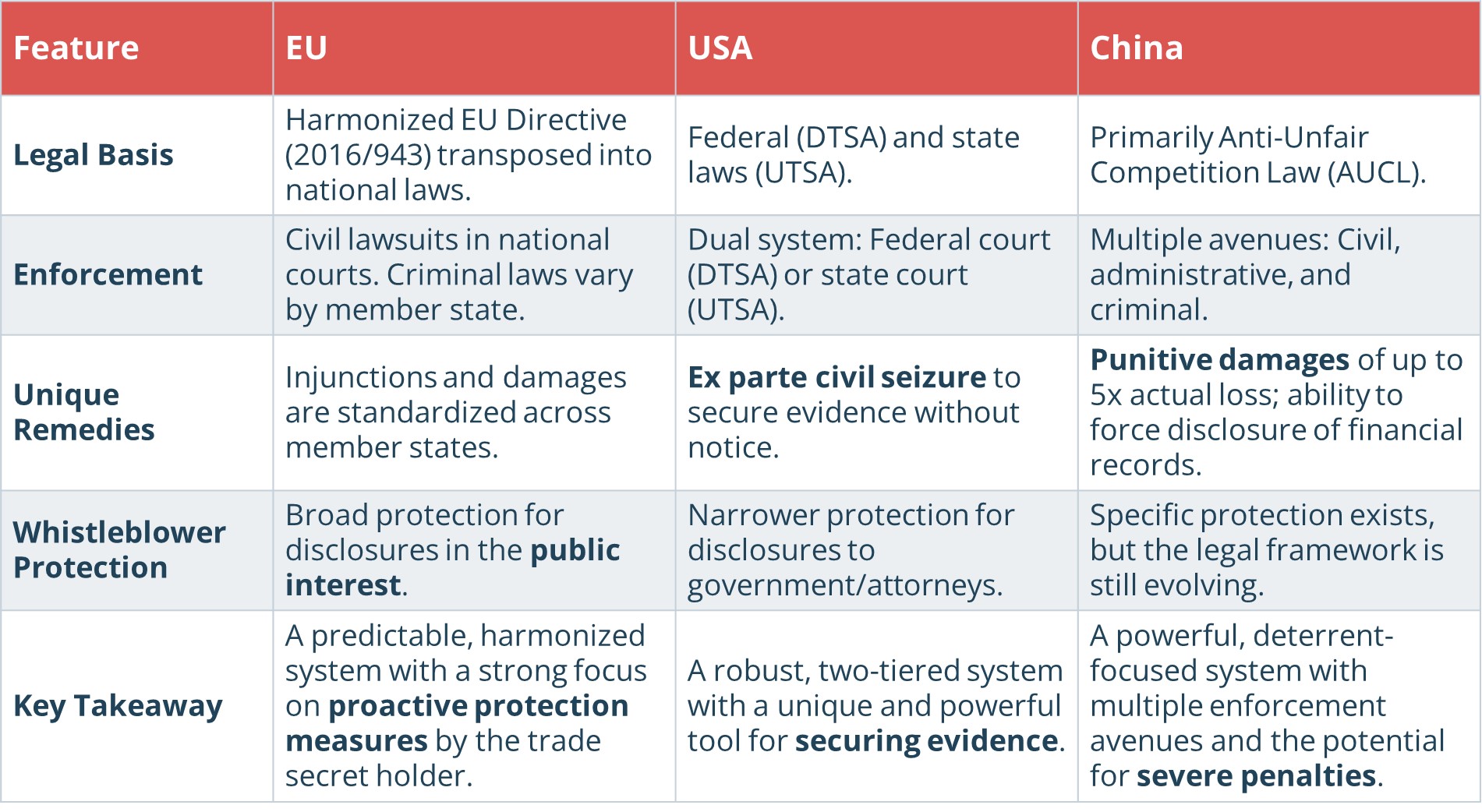
The European Union’s approach is defined by the EU Trade Secrets Directive (2016/943), which was a landmark effort to modernize and harmonize trade secret protection across all member states. Prior to the Directive, protection varied significantly, creating legal uncertainty for companies operating across borders. The Directive provides a common legal definition and a set of consistent civil remedies that have been transposed into national laws, such as the German Geschäftsgeheimnisgesetz (GeschGehG) and the French Code de commerce.
- A Consistent Legal Definition
Across the EU, the core definition of a trade secret is consistent. It must be secret, have commercial value from its secrecy, and be subject to reasonable secrecy measures. Courts across the EU, including in Germany and France, interpret “reasonable secrecy measures” similarly. They look for a structured system of protection, including contractual measures like robust Non-Disclosure Agreements (NDAs), technical measures like encryption and access controls, and organizational measures like a “need-to-know” policy. The burden of proof for having these measures in place falls squarely on the trade secret holder. - Harmonized Remedies
The Directive harmonizes the civil remedies available in all member states. This includes injunctions to stop the infringement👉 Unauthorized use or exploitation of IP rights., monetary damages to compensate for losses (based on methods like lost profits or a reasonable royalty), and the destruction of infringing goods. The goal is to provide a consistent and predictable legal environment for businesses throughout the single market. - Strong Whistleblower Protection
A significant feature of the EU system is its broad protection for whistleblowers. The Directive explicitly states that the acquisition, use, or disclosure of a trade secret is not unlawful if it is for “revealing misconduct, wrongdoing or illegal activity,” provided the whistleblower acted in the public interest. This provision balances the protection of corporate secrets with the need for transparency and public accountability.
The USA: Federal law with strong state-level support
The United States has a dual system of trade secret protection. For decades, it relied on state-level laws, primarily through the adoption of the Uniform Trade Secrets Act (UTSA). This was supplemented in 2016 by the federal Defend Trade Secrets Act (DTSA), which allows companies to sue for trade secret misappropriation in federal court.
- DTSA vs. UTSA
A key difference lies in the jurisdiction and the legal standard. The UTSA is a state law, meaning a company would sue in state court, and the outcome could be influenced by a specific state’s interpretation of the law. The DTSA provides a federal cause of action, allowing companies to sue in federal court. This is particularly useful for cases involving interstate or international commerce. Filing in federal court is often preferred for its perceived procedural efficiencies, experienced judges in complex IP matters, and the availability of nationwide injunctions. - Ex Parte Civil Seizure
A unique and powerful remedy under the DTSA is the “ex parte civil seizure.” This allows a court, under extraordinary circumstances, to order the seizure of property related to the trade secret (e.g., computers, documents) without prior notice to the defendant. The purpose is to prevent the destruction of evidence. To obtain this, a trade secret holder must meet very strict criteria, including a high likelihood of success and a clear showing that the defendant would likely destroy or hide evidence if given notice. The plaintiff must also post a bond to protect the defendant in case the seizure was wrongful. - Damages and Whistleblower Protection
The DTSA provides a robust framework for damages, allowing for both actual damages and, in cases of willful and malicious misappropriation, exemplary damages of up to twice the amount of actual damages. The court can also award attorney’s fees. Regarding whistleblower protection, the DTSA’s immunity provision is narrower than the EU’s, protecting employees who disclose a trade secret to a government official or an attorney for the purpose of reporting a “suspected violation of law.”
China: A powerful, deterrent-focused system
Historically, China’s trade secret protection was considered weak. However, in recent years, the Chinese government has significantly strengthened its legal framework, primarily through amendments to its Anti-Unfair Competition👉 Rivalry between entities striving for a shared goal or limited resource. Law (AUCL), to protect both domestic and foreign innovation👉 Practical application of new ideas to create value.. These reforms have made China’s system one of the most powerful and deterrent-focused globally.
- Strong Punitive Damages
China’s legal system now offers some of the strongest remedies. The AUCL allows for punitive damages of up to five times the amount of the actual loss. This powerful deterrent is awarded in cases of “intentional infringement with serious circumstances,” which can include scenarios where the infringer continued their actions after being notified, or where the infringement resulted in significant financial losses. Furthermore, recent amendments have significantly increased the maximum amount of statutory damages, making it easier for plaintiffs to receive compensation even when actual damages are hard to prove. - Multiple Enforcement Avenues
Unlike the EU and USA, a company in China has three parallel avenues for enforcement:- Civil Litigation: The primary route for seeking damages and injunctions.
- Administrative Complaint: A company can file a complaint with the local Administration for Market Regulation (AMR). This is a faster and less expensive option, often leading to a fine for the infringer and an order to cease the activity.
- Criminal Enforcement: Trade secret theft is a serious criminal offense in China. Amendments to the Chinese Criminal Law have lowered the threshold for criminal liability, and the potential for heavy fines and imprisonment is a very strong deterrent.
- Evidence and Procedure
Recent legal reforms in China have also eased the burden of proof for trade secret holders, particularly in cases where there is a strong likelihood of infringement. The courts can also order defendants to provide their accounting books to help in calculating damages, a measure that is not always available in other jurisdictions.