Once a company discovers that one of its trade secrets has been stolen or misused, the immediate priority is to stop the damage and seek recourse. The legal landscape in Germany offers multiple avenues to achieve this, each with a different focus and a unique set of remedies. The most common and powerful tool is civil litigation under the Geschäftsgeheimnisgesetz (GeschGehG), but a company’s strategy may also involve criminal prosecution or actions under the German Act Against Unfair Competition👉 Rivalry between entities striving for a shared goal or limited resource. (UWG). This chapter explores these three distinct legal paths, providing a comprehensive overview of how a company can enforce its rights and what to expect during the process.
Civil proceedings under the GeschGehG: The primary path to justice
For most companies, civil litigation is the cornerstone of their legal strategy against trade secret👉 Protects confidential business info for competitive advantage. misappropriation. The main goal of a civil lawsuit is to enforce a company’s private rights—that is, to stop the infringement👉 Unauthorized use or exploitation of IP rights. and recover the financial damages caused. The GeschGehG provides a clear framework for this, offering several powerful legal remedies.
Claims for injunctions
An injunction is a court order that forbids a person from performing a specific act. For trade secret misappropriation, it is the most critical and often the first remedy sought. The purpose of an injunction is to immediately stop the unauthorized use or disclosure of the trade secret, preventing further harm to the company.
- Standard Injunction
In a regular lawsuit, the court can issue a permanent injunction once it has confirmed the misappropriation. This is a final court order that legally prohibits the infringer from continuing their unlawful actions. - Preliminary Injunction
In cases where time is of the essence, a company can apply for a preliminary injunction. This is a fast-track procedure designed to provide immediate, temporary relief while the full lawsuit is still pending. To obtain one, a company must demonstrate both the existence of a trade secret and an urgent need for protection, showing that waiting for a full trial would cause irreparable damage. - Example
A former employee starts a new company using your confidential production process. A preliminary injunction can be issued within weeks, legally forcing them to stop all production and use of the secret, thereby preventing your competitor from gaining an immediate market advantage.
Claims for removal and destruction
These claims go beyond simply stopping the activity; they seek to reverse the damage. A company can demand that the infringer take specific actions to eliminate the effects of the misappropriation.
- Destruction
This can be a demand for the infringer to destroy any products, documents, or data carriers that were created using the stolen trade secret. For instance, if an entire production run of a product was made using your secret process, you could demand that the inventory or parts of it be destroyed or that modifications be made to it. - Removal from the market
This claim allows a company to demand the recall of products from the market that were made with the misappropriated secret. - Example
A competitor illegally acquires your confidential customer list and uses it to send targeted marketing materials. You could demand not only that they stop using the list but also that they delete all copies of the data from their servers.
Claims for information
To effectively assess damages and identify the full scope of the infringement, a company needs information. The GeschGehG gives a company the right to demand information from the infringer.
- What can be demanded?
This includes details about the origin, quantity, and distribution channels of infringing goods or services; the names and addresses of distributors and customers; and the extent to which the trade secret was used or disclosed. - Example
If a competitor has used your secret design to create a product, you can demand to know how many units they have sold and to which retailers, allowing you to calculate your lost profits more accurately.
Claims for damages
This is the financial remedy for the harm suffered. A successful claim for damages can be based on several different calculation methods under German law:
- Lost profits
A company can claim the profit it lost as a direct result of the misappropriation. This is often difficult to prove, as it requires showing a direct causal link. - Infringer’s profits
The company can demand the profits that the infringer made from using the stolen secret. This is a common method as it is often easier to prove than one’s own lost profits. - Reasonable royalty
The company can claim a hypothetical license fee—the amount that the infringer would have had to pay if they had lawfully licensed the trade secret.
The parallel path: Criminal proceedings
While civil lawsuits focus on compensation, the German legal system also recognizes that trade secret theft can be a criminal offense. Under § 23 GeschGehG, the unauthorized acquisition, use, or disclosure of a trade secret can be punishable by up to three years in prison or a fine. In particularly severe cases, the penalty can be even higher.
Key differences from civil proceedings
- Initiation
A criminal investigation is typically initiated by a formal criminal complaint from the victim. The state prosecutor then decides whether to pursue the case based on public interest. - Goal
The goal of a criminal case is punishment, not financial compensation for the victim. While criminal proceedings can lead to a fine, the primary aim is to hold the perpetrator accountable to the state. - Burden of proof
The burden of proof is much higher in a criminal case than in a civil one. The prosecution must prove guilt “beyond a reasonable doubt.”
When is an act a crime?
Not every civil breach rises to the level of a criminal offense. A criminal act under § 23 GeschGehG requires a higher degree of intent. It typically involves actions such as intentionally spying to obtain a secret, or a person who has lawful access to a secret intentionally discloses it without authorization to harm the company.
- Example
A disgruntled employee, before leaving the company, intentionally downloads the entire customer database and sells it to a competitor. This act would likely be considered a criminal offense, as it was a deliberate act performed with the intent to harm the company for personal gain. In contrast, an employee who accidentally sends a confidential file to a client would likely only face a civil claim.
The role of the UWG (German act against unfair competition)
Before the GeschGehG, the UWG was a primary legal tool for protecting trade secrets. Today, the GeschGehG provides the comprehensive and specific framework for these matters. However, the UWG still has a role to play in certain cases.
The UWG and trade secrets today
The GeschGehG is now the exclusive law for claims related to the misappropriation of a trade secret. But the UWG can still be relevant if the theft of the secret is part of a broader, unfair competitive act that goes beyond the mere misuse of the information.
- Example
A competitor hacks into your server to steal your new product design and then immediately launches a marketing campaign falsely claiming that your company stole their idea. While the hacking and theft fall under the GeschGehG, the false marketing campaign could be pursued as an act of unfair competition under the UWG.
Protecting secrets during the litigation process
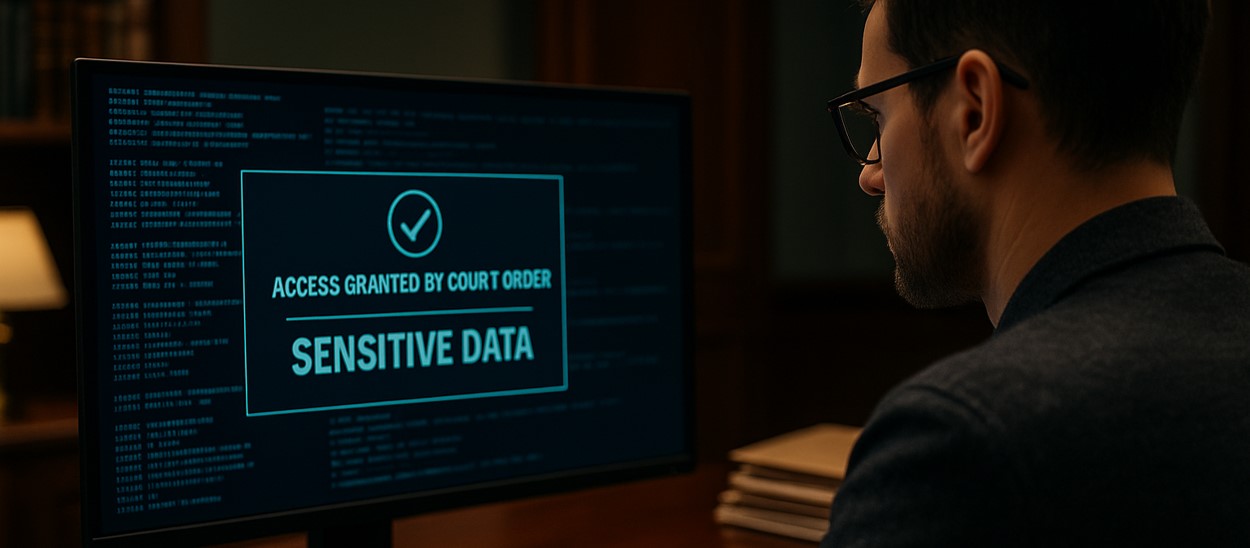
A significant concern for any company engaging in trade secret litigation is that the secrets themselves might be further disclosed during the court proceedings. The German legal system recognizes this risk👉 The probability of adverse outcomes due to uncertainty in future events. and provides mechanisms to protect the confidentiality of the secret while the case is being heard.
- Confidentiality order
The court can issue a confidentiality order to ensure that the secret is only disclosed to a limited number of individuals involved in the case (e.g., the parties, their lawyers, and experts). - In-camera proceedings
The court can order that parts of the proceedings be held in private, excluding the public, to protect the confidentiality of the trade secret. - Redaction of documents
The court can order that confidential information in court filings be redacted or blacked out, with the full, unredacted versions only being made available to the parties and their lawyers.
Conclusion: A strategic approach to enforcement
Enforcing a company’s rights against trade secret misappropriation requires a careful and strategic approach. The primary path is a civil lawsuit under the GeschGehG, which provides the necessary tools — injunctions, claims for destruction, and damages — to stop the harm and receive compensation. In severe cases involving criminal intent, a parallel criminal complaint can be filed, which, while not offering direct compensation, can result in the punishment of the perpetrator. Finally, the UWG remains a relevant tool for addressing broader acts of unfair competition that may be intertwined with the theft of a trade secret. By understanding the purpose and scope of each of these legal paths, a company can build a comprehensive strategy to protect its most valuable assets.
