

Patent search👉 A systematic review of patents literature. strategies require not only technical understanding but also the ability to anticipate potential legal risks, including indirect patent👉 A legal right granting exclusive control over an invention for a limited time. infringement👉 Unauthorized use or exploitation of IP rights.. This is especially critical for Freedom-to-Operate (FTO) analyses, where it is essential to identify not only direct copies but also functionally equivalent alternatives that might still violate patent rights. The TRIZ👉 A systematic problem-solving method using universal inventive principles. (Theory of Inventive Problem Solving) approach, originally developed by Genrich Altshuller, provides a structured method for understanding complex technical systems and their functional interactions, making it an ideal tool for this purpose.
Why the TRIZ approach is critical for patent searches
Indirect patent infringement, which can arise when a product performs the same essential function as a patented invention👉 A novel method, process or product that is original and useful. without directly copying its exact components, presents a significant risk👉 The probability of adverse outcomes due to uncertainty in future events. for companies. This challenge is further complicated by the need to account for different terminology, varying technical implementations, and alternative design approaches that might achieve the same functional outcome. Traditional keyword-based search methods often fall short in capturing this complexity, leading to missed prior art or overlooked infringement risks.
The TRIZ-based System and Function Analysis helps address this gap by focusing on the functional relationships within a technical system. Rather than just searching for specific components, this approach identifies the interactions and effects that define a system’s core functionality. By mapping these functional interactions, it becomes possible to identify alternative technologies or component substitutions that may not share the same physical form but still pose a risk of infringement.
Key steps in the TRIZ system and function analysis
The TRIZ System and Function Analysis provides a structured approach for breaking down complex technical systems into their fundamental components and interactions. This process is essential for understanding the core functionality of a system, which in turn is critical for identifying potential patent risks, including indirect infringement. By focusing on the relationships between components and their respective functions, this method allows for a deeper understanding of both intended and unintended effects within a system. It also provides a systematic way to identify functionally equivalent alternatives that might not be immediately apparent through conventional keyword-based searches. This approach is particularly valuable in the context of Freedom-to-Operate (FTO) analyses, where comprehensive insight into potential infringement risks is required.
- Defining the system and its boundaries
The first step involves clearly defining the technical system under analysis, including its super-systems, sub-systems, and components. This boundary definition is crucial as it sets the context for understanding the functional relationships within the system. - Function identification (SAO Analysis)
The function analysis is a core element within the TRIZ-based approach, as it directly addresses the challenge of identifying indirect patent infringement. Unlike traditional component-focused searches, function analysis captures the intended and unintended interactions within a system, highlighting both primary and secondary effects. This deeper understanding is crucial for recognizing functionally equivalent alternatives that might not share the same physical form but perform similar actions. The SAO (Subject-Action-Object) model is particularly valuable here, as it breaks down each interaction within a system into its essential components: the element performing the action (Subject), the nature of the interaction (Action), and the target of the action (Object). This method not only provides clarity in defining core functionalities but also allows for a more comprehensive assessment of potential infringement risks.
For example, in a hand prosthesis, the function can be represented as “EMS Stimulator (Subject) stimulates (Action) Nerve (Object),” capturing the core technical effect regardless of the specific components involved.: Using the SAO approach, each function within the system is mapped in terms of the component (Subject) performing the action (Action) on another component (Object). For example, in a hand prosthesis, the function might be represented as “EMS Stimulator (Subject) stimulates (Action) Nerve (Object).” This method captures both the intended and unintended effects of the system.
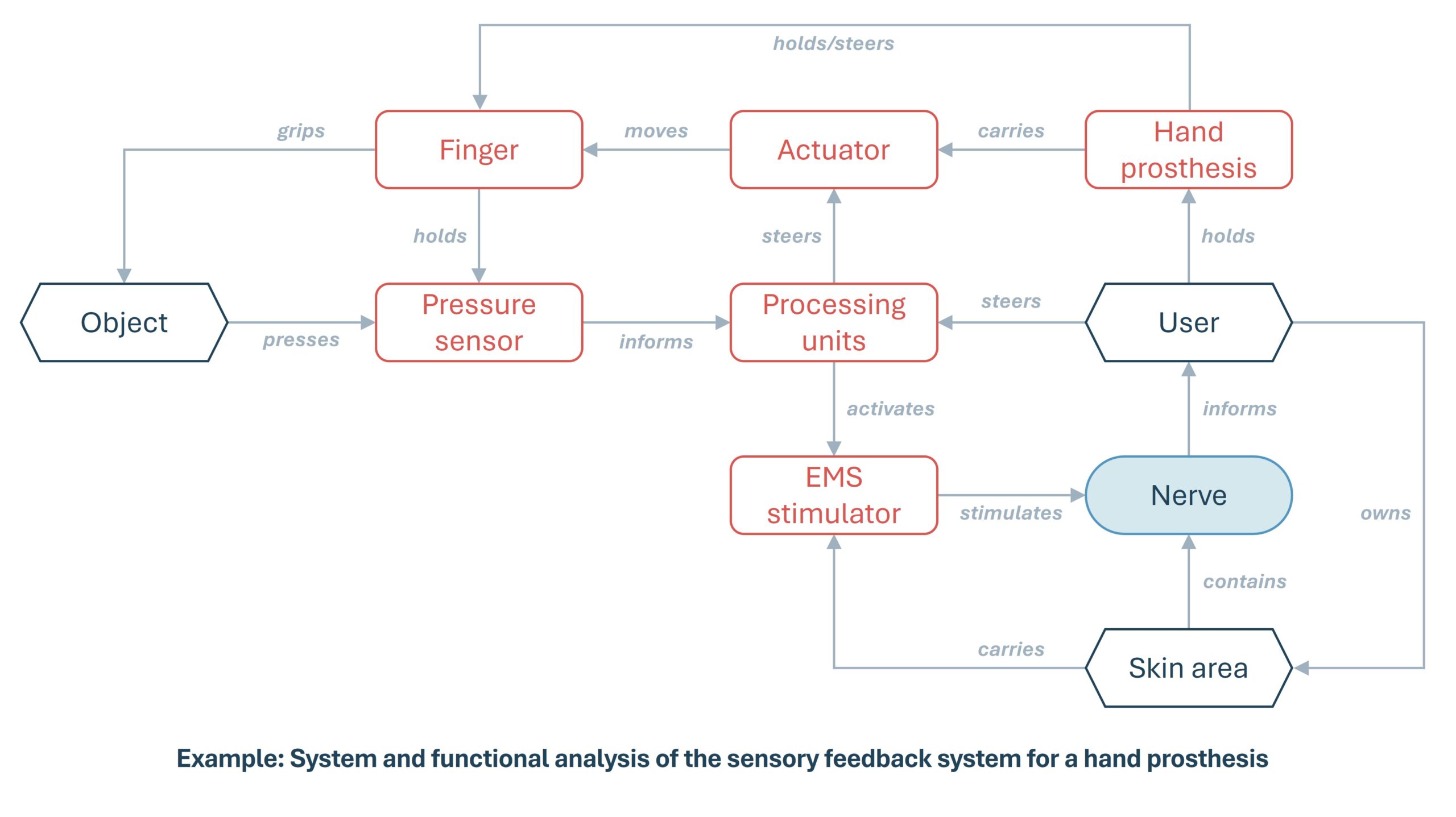
- Parameter and effect analysis
Each function is then broken down into its influencing parameters and the type of effect it generates. For example, the function “EMS Stimulator stimulates Nerve” can be further specified by identifying that it alters an electrical field parameter, which can either increase or decrease in real-time. This level of detail is critical for identifying indirect infringement risks, as it allows for the recognition of equivalent technologies. - Identifying alternative functional paths
Once the core functions are mapped, the analysis can be extended to consider alternative means of achieving the same functional effect. This process, known as “Trimming” in TRIZ, involves systematically removing or replacing components to identify potentially infringing alternatives that might bypass traditional keyword searches.
Integrating AI tools with the TRIZ methodology
The TRIZ-based System and Function Analysis can be further enhanced by integrating AI-powered search tools, which can significantly boost the efficiency and comprehensiveness of patent searches. While human intelligence excels at contextual understanding and strategic decision-making, AI systems can rapidly analyze vast amounts of data to identify potential functional equivalents and design alternatives. This combination is particularly effective when dealing with indirect infringement risks, where subtle functional similarities may not be immediately apparent through manual analysis alone.
For example, modern AI tools can leverage machine learning algorithms to identify patterns in patent data, automatically map SAO relationships, and detect functionally similar technologies based on their underlying effects and parameters. When paired with the structured approach of TRIZ, this creates a powerful hybrid strategy that captures both explicit and implicit technical variations, reducing the risk of missed prior art and overlooked infringement concerns.
Practical benefits of TRIZ in patent searches
The TRIZ-based System and Function Analysis provides several critical advantages for patent searches, particularly when the goal is to identify functionally equivalent alternatives and assess indirect infringement risks. This approach shifts the focus from purely component-based searches to a more comprehensive analysis of functional relationships, significantly broadening the search scope and improving the quality of results.
- Broader search scope
Traditional keyword-based searches often struggle to capture functionally equivalent but structurally different solutions, leading to overlooked prior art. TRIZ addresses this by focusing on the functional interactions within a system, allowing searchers to identify alternative technologies that achieve the same effect through different means. This is especially useful in FTO analyses, where even minor variations in design can have significant legal implications. - Improved FTO analysis
The method’s emphasis on functional relationships helps uncover indirect infringement risks that might not be immediately apparent when only considering specific components. By mapping the core functions and their effects, TRIZ enables the identification of alternative paths to achieving the same technical outcome, reducing the risk of missing potentially infringing designs. - Higher search quality
By systematically capturing the interactions between components, the TRIZ approach reduces the likelihood of missing critical prior art or alternative designs. It provides a structured framework that can account for both intended and unintended effects, helping researchers to better understand the broader landscape of technological alternatives. - Reduced false positives
Unlike conventional methods that can generate a high number of irrelevant results due to ambiguous keyword matches, the function-based focus of TRIZ helps reduce false positives by concentrating on the actual effects and interactions within the system, rather than just the physical components involved. - Support for AI integration
The structured nature of TRIZ makes it an ideal foundation for AI-powered patent search tools, which can leverage machine learning to automate the identification of functional relationships and technical effects, further enhancing the efficiency and accuracy of the search process.
Incorporating TRIZ-based System and Function Analysis into patent search strategies significantly enhances the ability to identify indirect patent infringement risks. By shifting the focus from component-based searches to function-based analyses, companies can better protect their innovations and reduce their exposure to costly legal disputes. As the complexity of technical systems continues to grow, this method provides a robust framework for navigating the increasingly intricate landscape of intellectual property👉 Creations of the mind protected by legal rights. rights.