
Licensing👉 Permission to use a right or asset granted by its owner. in IP management👉 Strategic and operative handling of IP to maximize value. is often misunderstood as a transaction. In many organizations, it is associated with negotiations, contracts, royalty rates and legal provisions. These elements are important. But they are not where licensing value is ultimately created.
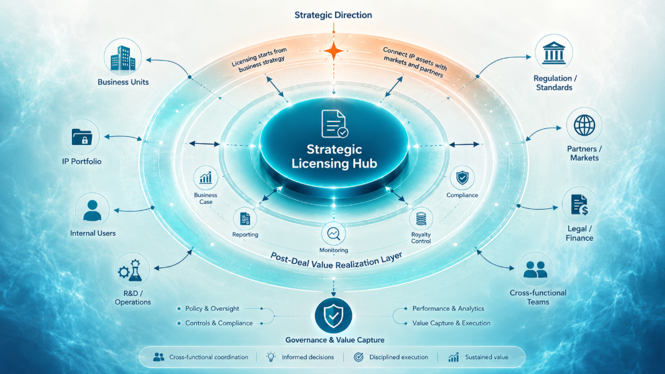
This Deep Dive builds on the documentation of the OFB Fireside Chat on licensing with Tomas Geerkens and Andreas Jacob, joined by Philip Vulev from TomTom and Vahram Papyan from BHP, both members of the Open Foresight Board. The discussion shows why licensing should not be understood merely as a deal-making activity, but as a strategic IP management capability that connects business objectives👉 Clear, measurable goals guiding a company’s strategy, priorities, and resource allocation., IP assets, partners, governance and post-deal value realization.
👉 https://ipbusinessacademy.org/licensing-beyond-deals-where-value-is-really-created
A licensing agreement can only create business value if it supports a strategic objective, fits the company’s operating model and is translated into clear responsibilities after the contract has been signed. Licensing therefore belongs first to IP strategy👉 Approach to manage, protect, and leverage IP assets.. It defines how intellectual property👉 Creations of the mind protected by legal rights. can support market access, revenue generation, risk management👉 Process of identifying, assessing, and controlling threats to assets and objectives., technology expansion and business model👉 A business model outlines how a company creates, delivers, and captures value. development.
The practical challenge is that licensing sits between functions. It connects IP teams, business units, finance, legal, management, product teams and external partners. This makes licensing a strategic IP management capability. It is not only about granting rights. It is about designing, organizing and controlling how IP becomes economic value in the business.

Related reading: The 📑IP Management Letter 🔬Research Nugget on IP Strategy explains why licensing should be understood as part of the company’s strategic management👉 Strategic management is the process of planning, implementing, and evaluating. logic. It provides the conceptual frame for treating IP not only as protection, but as a resource for market access, revenue generation and business model development.
👉 https://profwurzer.com/ip-strategy-is-a-functional-strategy/
Why licensing starts with business strategy
Licensing does not begin with patents, trademarks, technologies or legal documents. It begins with the business question. What does the company want to achieve? Where does it want to grow? Which markets are attractive but difficult to enter directly? Which technologies are valuable but not central to the current business model? Where could external partners create value that the company cannot capture alone?
This perspective changes the role of IP. IP is no longer treated as an isolated legal asset. It becomes a strategic resource that can support business objectives. A patent👉 A legal right granting exclusive control over an invention for a limited time. portfolio, a software asset, a brand👉 A distinctive identity that differentiates a product, service, or entity., technical know how, data or a protected design may all become relevant. But their relevance depends on the business context in which licensing is considered.
A company may use licensing to generate additional revenue from technologies that are not fully used internally. It may use licensing to enter new geographic markets through partners. It may license technology into adjacent industries where it has no direct commercial presence. It may also use licensing to create strategic alliances, reduce market risk👉 The probability of adverse outcomes due to uncertainty in future events. or support the adoption of a technical standard.
The key point is that licensing should not compete with the core business. It should complement it. If licensing weakens the company’s own competitive position, creates uncontrolled dependencies or confuses internal priorities, it can destroy value instead of creating it. This is why licensing strategy must define clear boundaries before individual opportunities are pursued.
Licensing therefore requires a shift in thinking. The question is not simply: Which IP rights could we license? The better question is: Which business objectives could be supported through controlled access to our IP assets?
Related reading: The article on 360 Degree IP Strategy shows how licensing fits into a holistic IP approach where business objectives, portfolio design, standards, market access and revenue models are considered together. This is especially helpful for readers who want to understand why licensing should not start with a contract, but with strategic intent.
👉 https://profwurzer.com/a-360-degree-ip-strategy/
Licensing as one strategic option among several
Licensing is not automatically the right answer whenever IP exists. It is one strategic option among several. A company may protect an asset exclusively for its own use. It may use IP defensively to secure freedom to operate👉 Strategic analysis to determine whether a product or service might infringe existing IP rights.. It may enforce rights against competitors. It may contribute technology to a collaboration. It may keep know how confidential. Or it may license selected rights under controlled conditions.
Good IP strategy compares these options. Licensing becomes attractive when external use of the asset can create value without undermining the company’s core position. This requires an assessment of markets, competitors, partners, product roadmaps, internal capabilities and long term strategic intent.
For example, a technology may be highly valuable but not central to the company’s current product strategy. In such a case, licensing may open additional revenue streams without distracting internal teams. Another technology may be central to a future product line. Licensing it too broadly could weaken the company’s own market position. In that case, exclusivity may be more valuable than royalties.
The same logic applies to brands, software, data, designs and technical know how. Not every asset should be licensed. Not every licensing opportunity should be accepted. The strategic task is to decide where controlled access creates more value than exclusive internal use.
This is why licensing should be embedded in portfolio strategy. IP portfolios should not only be reviewed according to legal status and maintenance costs. They should also be reviewed according to strategic use options. Which assets protect the core business? Which assets support partnerships? Which assets could be licensed? Which assets no longer fit the strategy? Which assets require stronger internal control?
Licensing becomes a management tool when these questions are answered systematically. It becomes a side activity when they are left to occasional opportunities.
Related reading: The article on out licensing explains how non core IP can become valuable when it is aligned with another company’s business need. It is a useful companion piece for the strategic question of when controlled external use creates more value than exclusive internal use.
👉 https://ipbusinessacademy.org/turning-non-core-ip-into-impact-out-licensing-through-smart-organization-culture-and-licensing-strategy
The real challenge begins after the deal
Many organizations treat the signing of a licensing agreement as the successful end point. From an IP management perspective, it is only the starting point. The economic value of a licensing agreement is created after the deal, not in the moment of signature.
This is where many licensing programs lose value. Agreements may be carefully negotiated, but the operational system behind them is weak. Reporting obligations may be unclear in practice. Product definitions may be interpreted differently by the parties. Royalty relevant sales may not be captured properly. Contractual restrictions may not be reflected in the licensee’s processes. Internal teams may not know who is responsible for follow up.
These problems are rarely caused by bad intent. More often, they arise because licensing is not organized as an ongoing management process. The agreement describes rights and obligations. But the organization must still turn those rights and obligations into routines, controls, data flows and responsibilities.
This is why licensing execution is a core part of strategic IP management. A licensing program needs governance. It needs monitoring. It needs reporting structures. It needs escalation paths. It needs people who understand both the contract and the business reality behind it.
Without such structures, the company may leave value unrealized. It may receive less revenue than expected. It may fail to detect underreporting. It may allow scope expansion beyond the intended field. It may lose transparency over where its IP is used. In extreme cases, the licensing program may become a source of risk rather than a source of value.
A mature licensing strategy therefore includes the post deal phase from the beginning. The question is not only how to negotiate the agreement. The question is how to operate it.
The organizational bottleneck in licensing
Licensing often fails for organizational reasons. The obstacle is not necessarily the absence of valuable IP. It is the absence of ownership, alignment and internal momentum.
Business units usually focus on their core activities. They may not see licensing as part of their responsibility. IP teams may understand the portfolio but may not have the commercial mandate to build licensing cases. Legal teams may focus on contract quality but may not own business execution. Finance may evaluate revenue assumptions but may not participate early enough. Management may support licensing in principle but hesitate to allocate resources.
The result is a gap. Valuable IP exists, but no one carries the full responsibility for turning it into a licensing opportunity. Licensing sits between departments, and therefore it can easily fall between departments.
This makes licensing an organizational design issue. Companies need to define who identifies licensing opportunities, who evaluates them, who prepares business cases, who approves negotiations, who manages partner relationships and who controls performance after signature. Without this clarity, even promising licensing opportunities can remain theoretical.
The solution is not always a large licensing department. In many companies, the better starting point is a clear process and a small cross functional team. The team may include IP, business, legal and finance perspectives. Its task is to identify concrete cases, evaluate strategic fit and create internal confidence.
Licensing becomes effective when it has a home in the organization. That home may be in the IP function, in business development, in technology transfer👉 The transfer of intangible goods to make scientific findings economically usable., in corporate strategy or in a dedicated licensing function. The exact structure depends on the company. But the responsibility must be visible.
Building licensing momentum through concrete cases
Large licensing strategies can be too abstract at the beginning. They often sound attractive, but they are difficult to implement because the organization lacks experience, data and internal support. A more practical approach is to start with concrete cases.
A concrete licensing case has a defined asset, a defined business context and a plausible external use scenario. It is not simply a general statement that the company has valuable IP. It identifies a specific technology, product component, software module, data asset, brand element, design or know how package that could create value outside the company’s current use.
This case based approach reduces complexity. It makes the opportunity easier to discuss. It allows the company to build a business case with clearer assumptions. It also helps internal stakeholders understand why licensing matters.
A good first case does not have to be the largest possible opportunity. It should be a case that is understandable, strategically safe and operationally manageable. The purpose is not only to create revenue. The purpose is also to build organizational learning.
Once a company has worked through one licensing case, it understands much more about internal data, portfolio quality, approval processes, partner selection, contract execution and reporting. This learning can then be used to build a more structured licensing capability.
Licensing strategy therefore develops through practice. It becomes stronger when concrete cases reveal what the organization can already do and what it still needs to build.
Related reading: The CEIPI MIPLM exam case on IP Licensing gives a concrete learning scenario for licensing as a value creation tool. It is useful for readers who want to see how portfolio economics, licensing models, compliance mechanisms and strategic exploitation can be combined in one applied case.
👉 https://ipbusinessacademy.org/could-you-have-answered-that-cracking-the-ceipi-miplm25-exam-on-ip-licensing
Managing the trade off between exclusivity and value creation
Licensing creates a strategic tension. On the one hand, companies want to protect their competitive advantage. On the other hand, licensing can create additional value by allowing others to use selected assets. This tension cannot be solved by a general rule.
The central management question is where exclusivity creates more value and where controlled access creates more value. In some areas, exclusivity is essential because the asset is directly linked to the company’s differentiation. In other areas, external use may create revenue, adoption, ecosystem effects or market learning without harming the core business.
This requires clear licensing boundaries. A company may define geographic limits, field of use restrictions, customer segment restrictions, technology scope limits or time based limitations. It may license older technology while keeping next generation technology exclusive. It may license into non competing markets. It may license production know how but keep certain data assets internal. It may allow use under strict reporting and audit rights.
Even licensing to competitors can be strategically reasonable in some cases. But it must be controlled. The company must understand what value it gives access to, what value it receives in return and how the arrangement affects its long term position.
This is where IP strategy and business strategy must be closely aligned. A licensing decision cannot be evaluated only by expected royalty income. It must also be evaluated by strategic risk, market effect, learning potential, partner dependency, future product plans and the company’s intended position in the value chain👉 A series of activities that create and deliver value in a product for end-users..
Licensing is therefore not a simple monetization tool. It is a strategic design choice about openness and control.
Making the internal business case for licensing
Licensing opportunities are often difficult to present internally. The expected value is uncertain. Revenues depend on partner behavior, market adoption, reporting quality and execution. This makes licensing different from many core business investments, where internal teams may have more direct control.
To make a licensing case credible, the organization needs a clear value narrative. The case should explain which business objective is supported, why licensing is the appropriate mechanism, which asset is involved, which partner or market segment is relevant and how the company can control the main risks.
Financial assumptions are important, but they are not sufficient. A licensing business case should also show strategic fit. It should explain whether licensing supports market expansion, technology adoption, ecosystem positioning, cost sharing, risk reduction or portfolio utilization.
External benchmarks can help. They can show that other companies have created meaningful licensing revenue or strategic value from comparable assets. Benchmarks should not be used as simple promises. They should be used to create awareness and to make the opportunity more tangible for management.
Internal communication is especially important. Licensing should not be presented as an abstract IP opportunity. It should be presented as a concrete contribution to business goals. The language must therefore connect IP assets with business outcomes.
This is also where IP valuation becomes relevant. Valuation does not remove uncertainty. But it provides a structured way to discuss assumptions, scenarios, revenue potential, risk and decision quality. In this sense, IP valuation supports licensing strategy by giving economic language to IP based opportunities.
Licensing governance and performance control
A licensing strategy needs governance. Governance defines how licensing decisions are made, who is accountable, how performance is monitored and how problems are escalated. Without governance, licensing remains dependent on individual initiative and informal follow up.
Good licensing governance begins before negotiation. It defines which opportunities are worth pursuing, which assets may be offered, which internal approvals are required and which strategic limits apply. It also defines who may speak to potential licensees and who owns the negotiation process.
During negotiation, governance ensures that business, IP, legal and finance perspectives are aligned. The contract must reflect the strategic purpose of the licensing arrangement. It must also be operational enough to be executed. If reporting obligations, product definitions, audit rights, sublicensing provisions and territory restrictions are vague, value capture becomes difficult later.
After signature, governance becomes even more important. The organization needs mechanisms to monitor sales reports, royalty calculations, product scope, field of use compliance, milestone obligations and partner behavior. It also needs clear escalation rules when discrepancies arise.
Licensing performance control should not be seen as distrust. It is part of professional licensing management. Both parties benefit when obligations are clear, data is reliable and expectations are transparent.
This is why licensing belongs not only to IP strategy, but also to IP organization and IP controlling. Strategy defines why licensing matters. Organization defines who makes it happen. Controlling ensures that agreed value is actually realized.
Licensing in digital and data based business models
Digital transformation👉 Using digital technology to redesign processes, culture, and value creation now. makes licensing more complex. In traditional licensing, the licensed asset may be a patent, a trademark👉 A distinctive sign identifying goods or services from a specific source., a design or a defined technology package. In digital business models, value may also sit in software, data, algorithms, user interfaces, platforms, APIs, workflows, training data, analytics models and system integration know how.
This changes the licensing question. The company must define not only which right is licensed, but also which access is granted. Is the licensee allowed to use software internally? May it integrate an API into its own system? May it access data? May it train models? May it modify code? May it sublicense? May it combine the licensed element with third party components?
Digital licensing also increases the importance of operational monitoring. Usage may be continuous, automated and difficult to observe through traditional reporting. Technical access control, usage logs, data governance, cybersecurity, audit mechanisms and contractual clarity become part of the licensing system.
In data based business models, the boundary between IP, confidentiality, contract and technical control becomes especially important. Data may not always be protected by classic IP rights in the same way as patents or trademarks. Its value may depend on exclusivity, quality, structure, access restrictions and the ability to combine it with other resources.
This means that licensing in digital business models must be designed as a combination of legal rights, technical architecture and business process. The contract alone is not enough. The licensing system must reflect how the technology is actually used.
For IP strategy, this creates a broader task. The company must identify which digital assets can be shared, under which conditions, through which technical interfaces and with which safeguards. Licensing becomes part of digital business model design.
Related reading: The Adobe Creative Cloud case shows how the shift from traditional licensing to subscription based digital access changes the IP logic of a business model. It is useful for readers who want to understand licensing in software, platform and SaaS contexts.
👉 https://profwurzer.com/adobes-shift-to-saas-creative-cloud-as-a-case-study-in-ip-backed-transformation/
From licensing projects to licensing capability
A company may start with one licensing project. But the long term goal is to build a licensing capability. A capability is more than a successful deal. It is the repeatable ability to identify, evaluate, negotiate, execute and improve licensing opportunities.
This capability requires several elements. The first is portfolio transparency. The company must know which assets it has and how they relate to technologies, products, markets and business units. The second is strategic alignment. Licensing must support business priorities. The third is organizational ownership. Someone must be responsible for moving opportunities forward.
The fourth element is process. Licensing needs a route from idea to business case, approval, negotiation, contract execution and performance control. The fifth element is data. Revenue, partner reporting, portfolio relevance, usage scope and compliance information must be available in a usable form.
The sixth element is learning. Each licensing project should improve the company’s understanding of where licensing works, where it does not work and which internal changes are needed. This learning is valuable because licensing often crosses departmental boundaries that are otherwise not well connected.
When these elements come together, licensing becomes more than monetization. It becomes a strategic management capability that helps the company use its intellectual assets more actively.
Related reading: The Smart Licensing Models documentation gives a practical structure for turning IP into licensing value. It connects legal rights with commercial objectives, valuation, taxation, compliance and global regulatory considerations.
👉 https://profwurzer.com/diplex/docs/smart-licensing-models/
The role of IP experts in strategic licensing
Strategic licensing requires IP expertise, but it also requires business understanding. IP experts must therefore move beyond a purely rights based view. They need to understand business models, value chains, competitive dynamics, partner incentives and operational execution.
Their role is not only to say whether a right exists. Their role is to explain what the right can do for the business. They help identify which assets are suitable for licensing, which assets should remain exclusive, which risks must be controlled and how licensing can be integrated into the company’s strategic objectives.
In many organizations, IP experts also act as translators. They translate technical and legal assets into business options. They help business units understand why IP may matter beyond protection. They help management see where intangible assets can create measurable value. They help legal and finance teams structure agreements that can be executed and monitored.
External IP experts can also contribute to licensing capability. They may bring market knowledge, comparable cases, valuation perspectives, licensing model experience and negotiation support. But their contribution is strongest when it is aligned with the company’s business context.
This is why licensing advice should not start with template agreements. It should start with strategic diagnosis. What is the business objective? Which assets matter? Which use cases are realistic? Which internal stakeholders must be involved? Which organizational bottlenecks must be solved?
The more licensing is understood as strategic IP management, the more important this advisory role becomes.
Building a licensing ready IP organization
A licensing ready IP organization does not need to license everything. It needs the ability to decide consciously where licensing makes sense and where it does not.
The first step is to create transparency. The organization should map relevant IP assets to products, technologies, markets, business units and strategic options. This does not have to be perfect at the beginning. But without a basic map, licensing opportunities remain accidental.
The second step is to define criteria. Which assets may be considered for licensing? Which assets protect the core business and should remain exclusive? Which markets are attractive for licensing? Which partners are acceptable? Which risks are unacceptable?
The third step is to establish ownership. Licensing needs a responsible function or team. It also needs access to decision makers in business, IP, legal, finance and management. Without this connection, licensing will not move from idea to execution.
The fourth step is to build a process. The organization should define how licensing opportunities are proposed, assessed, approved, negotiated and monitored. This process should be practical enough to be used. Overly complex processes can stop licensing before it starts.
The fifth step is to create a performance system. Licensing value must be tracked. This includes revenue, reporting quality, compliance, strategic effects and lessons learned. The goal is not only to collect royalties. The goal is to understand whether licensing is actually creating value.
The sixth step is cultural. People in the organization need to understand that IP is not only about protection. It can also be used to shape business relationships, open markets, support partnerships and create new value streams. This requires IP awareness across functions.
A licensing ready IP organization is therefore a more mature IP organization. It treats licensing not as an occasional transaction, but as a structured way to turn intellectual assets into business value.
Licensing as part of IP strategy
Licensing belongs at the center of strategic IP management because it forces a company to answer fundamental questions. What intellectual assets do we have? Where do they create value? What should we control exclusively? What can we share under defined conditions? Which partners can help us create value? Which operational structures are needed to capture that value?
These questions show why licensing is broader than contract law. The contract is necessary, but it is only one part of the system. Licensing value depends on strategic fit, organizational ownership, performance control, internal communication and continuous learning.
The most important shift is from deal thinking to capability thinking. A deal can create a moment of opportunity. A capability allows the organization to identify and realize such opportunities repeatedly.
In this sense, licensing is not a side activity of IP management. It is one of the clearest examples of how IP can become a business asset. It connects protection with use, ownership with access and legal rights with economic outcomes.
Companies that build licensing as a strategic capability are better positioned to capture the value of their IP. Companies that treat licensing only as a contract may have valuable rights, but they risk leaving much of that value unused.
Related reading: The Qualcomm case shows why recurring royalty streams require more than strong patents and contracts. It highlights the hidden discipline behind licensing systems where compliance, transparency and relationship stability are essential for sustained value capture.
👉 https://profwurzer.com/no-surprises-in-royalty-streams-the-hidden-discipline-behind-qualcomms-licensing-empire/
