
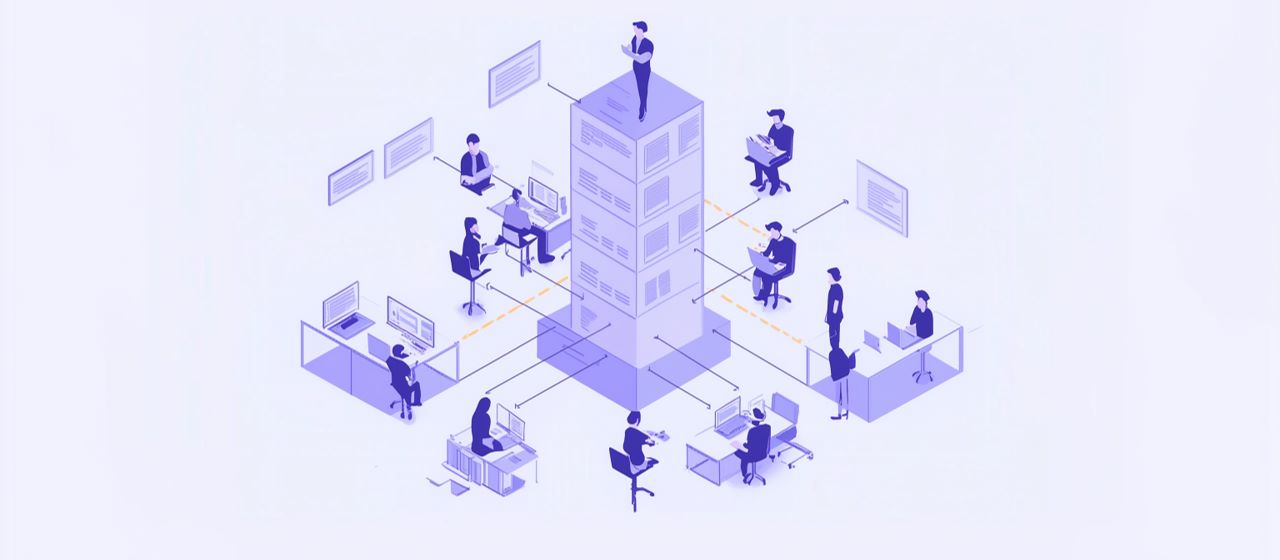
Understanding how a business is organized is fundamental to its effectiveness and efficiency. Organizational structure defines how jobs are divided, grouped, and coordinated, playing a critical role in communication, decision-making, and overall performance. Key concepts in business organization include work specialization, delegation, centralization vs. decentralization, departmentalization, and the common structural forms of functional vs. divisional structures.
Work Specialization
Work specialization, also known as division of labor, is the degree to which tasks in an organization are subdivided into separate jobs. Instead of an entire job being done by one individual, it’s broken down into a number of steps, with each step completed by a different person. This concept dates back to Adam Smith’s observation in the 18th century that pin factories could achieve significantly higher output by having workers specialize in individual steps of pin manufacturing rather than each worker making an entire pin.
This approach offers compelling benefits. By repeatedly performing the same narrow task, workers develop expertise, become faster, and make fewer errors, leading to significantly increased efficiency and productivity. Training employees for highly specialized tasks is also quicker and less expensive than training them for a broad range of skills, reducing overall training time and cost. Furthermore, this specialization fosters a deeper level of skill and knowledge within each specific area, ensuring better utilization of equipment tailored to those specialized tasks.
However, the downsides are equally significant. The repetitive nature of highly specialized tasks can lead to job monotony and boredom, often resulting in reduced job satisfaction, demotivation, and an increase in employee turnover. Such a structure also makes an organization less flexible and adaptable; highly specialized workers may struggle to adjust to changes in tasks, processes, or technologies. Employees might also lose sight of how their individual task contributes to the overall product or service, diminishing their sense of contribution. Moreover, this specialization can create “silos” where employees primarily interact within their narrow functional area, leading to poor communication and coordination across departments. Finally, an organization becomes over-reliant on specialists, meaning if a key specialist leaves, it can create significant operational disruption.
Delegation
Delegation is the process by which a manager assigns authority to a subordinate to perform specific tasks. It involves entrusting responsibility and authority to an individual to carry out duties that would otherwise fall on the manager. Effective delegation isn’t just about offloading tasks; it involves granting the necessary power to make decisions and act within defined limits.
The act of delegating yields substantial advantages for both managers and employees. Managers can free up their time to focus on more strategic, high-level tasks that require their unique expertise, leading to managerial time savings. For employees, delegation provides invaluable development and growth opportunities as they learn new skills, take on more responsibility, and enhance their capabilities. This empowerment often translates into increased employee motivation and engagement, as feeling valued and trusted significantly boosts morale and job satisfaction. Decisions can also be made more quickly and effectively, as they are brought closer to the source of the problem or opportunity. Employees closer to the operational details often possess more relevant information, leading to faster and often improved quality of decisions.
Despite its benefits, delegation also presents challenges. Managers may harbor a perceived or actual loss of control over the quality or outcome of the work, making them reluctant to delegate. There’s also the risk👉 The probability of adverse outcomes due to uncertainty in future events. of poor performance if the subordinate lacks the necessary skills, knowledge, or motivation, potentially impacting task completion standards. Managers might sometimes unevenly distribute workloads, leading to burnout for some and underutilization for others. Effective delegation demands that managers invest time in training and coaching subordinates, which can be a significant commitment. In less healthy organizational cultures, delegation can sometimes devolve into managers merely “passing the buck” to avoid accountability, rather than fostering genuine development or efficiency.
Centralization vs. Decentralization
Centralization refers to the degree to which decision-making authority is concentrated at the top levels of an organization. In a highly centralized organization, top management makes most of the decisions, and lower-level managers and employees primarily implement those decisions. In contrast, decentralization is the degree to which decision-making authority is dispersed downwards to lower levels in the organization. In a highly decentralized organization, lower-level managers and employees have significant autonomy to make decisions relevant to their areas of responsibility.
A centralized structure offers several advantages. It promotes consistency and control, making it easier to ensure uniform policies, procedures, and strategies across the entire organization. This structure typically features a clear chain of command, simplifying communication and reporting lines. It can lead to reduced costs by minimizing the duplication of functions and expertise, potentially achieving economies of scale and lower administrative overhead. In stable environments, top management, having all necessary information, can make faster decisions. It also helps maintain a strong, unified leadership and vision from the top.
However, centralization comes with notable drawbacks. Decision-making can be slow in dynamic environments as information travels up the hierarchy and approvals travel back down, hindering agility. It can also lead to reduced employee motivation and innovation👉 Practical application of new ideas to create value. if employees feel disempowered and have little say in decisions, stifling creativity. Top management might not fully grasp the unique challenges or opportunities at lower levels or in different regions, leading to a lack of responsiveness to local conditions. Finally, the concentration of decisions can overburden top management, creating bottlenecks and potential for burnout.
Conversely, a decentralized structure boasts distinct advantages. It allows for faster decision-making and responsiveness as choices are made by those closest to the information and the problem, significantly increasing organizational agility. This empowerment and autonomy can dramatically increase employee motivation and engagement, boosting morale and job satisfaction. Managers on the ground can better adapt to local conditions, tailoring decisions to specific market needs, customer preferences, or regional challenges. It also serves as an excellent mechanism for developing managerial skills, providing opportunities for lower-level managers to gain decision-making and leadership experience, while reducing the burden on top management, freeing them to focus on strategic planning.
Yet, decentralization also presents challenges. It can lead to a lack of consistency as different departments or units may adopt varying policies or practices across the organization. There’s a potential for duplication of efforts and resources as decentralized units might each require their own support functions (e.g., HR, marketing), leading to redundancy and higher costs. The autonomy can also breed conflicts as units compete for resources or have conflicting priorities. Top management may also struggle with a loss of control, finding it difficult to monitor and coordinate activities across highly autonomous units. Lastly, implementing company-wide initiatives can become challenging if each unit is accustomed to operating independently.
Departmentalization
Departmentalization is the basis by which jobs are grouped together. Once jobs have been specialized, they need to be grouped in a logical way to facilitate coordination and control.
One common form is functional departmentalization, where jobs are grouped by the functions performed. For example, a company might have departments for marketing, finance, human resources, production, and research and development. This structure significantly boosts efficiency from specialization by achieving economies of scale, as employees with common skills and knowledge are placed together. It fosters deep skill development within each functional area and provides clear career paths. Supervision is also simplified, as managers only need expertise in one functional area. However, this model often suffers from a “silo effect”, leading to poor cross-functional communication and coordination. Employees may develop a narrow functional focus, prioritizing departmental objectives over company-wide goals. Decision-making can be slow when it requires input from multiple functions, and it often limits the development of general managers, as they tend to specialize rather than gaining broader business exposure.
The alternative is divisional departmentalization, which groups jobs by product, service, customer, or geographical region. Each division operates almost like a separate, self-contained business unit, often with its own functional departments. This structure can be subdivided into:
- Product/Service Departmentalization: Grouping based on specific products or services. This approach allows for a strong focus on specific products, improved coordination within product lines, and clear accountability for product performance, making it suitable for diversified companies. The downside is the potential for duplication of resources and the risk of product divisions competing against each other, making it difficult to maintain a consistent company-wide image.
- Geographical Departmentalization: Grouping based on geographic territories. This structure enables better adaptation to local market conditions, improved local coordination, and better face-to-face communication with local customers and suppliers, proving effective for large-scale operations. However, it also leads to duplication of resources and functions and difficulties in maintaining consistent policies across regions, often increasing administrative costs.
- Customer Departmentalization: Grouping based on specific customer segments. This method prioritizes specific customer needs, leading to improved customer service and satisfaction, and fostering specialized knowledge of customer segments. Its drawbacks include duplication of resources, the potential for conflict among customer groups, and limited career progression for employees within the narrow customer focus.
Overall, a divisional structure offers increased flexibility and responsiveness, as each division can react quickly to changes in its specific market or customer segment. It provides clear accountability, as the performance of each division can be easily measured, often as a profit center. This structure also aids in the development of general managers, who gain broad experience managing all aspects of a division. Coordination within divisions is often easier, as activities related to a specific product, region, or customer are closely aligned. However, the most significant disadvantage is the duplication of resources, as each division often requires its own functional departments, leading to higher overall costs and potential inefficiencies. This can also lead to siloed divisions that focus only on their own goals, fostering competition👉 Rivalry between entities striving for a shared goal or limited resource. rather than collaboration. Top management may also struggle to maintain central control and a unified corporate culture, and the structure generally incurs increased administrative costs.
Conclusion
The choice of organizational structure is a strategic decision that profoundly impacts an organization’s ability to achieve its objectives. There is no single “best” structure; the most effective design depends on various factors such as the organization’s size, strategy, technology, environment (stable vs. dynamic), and culture. Businesses often employ hybrid structures that combine elements of different approaches to leverage their advantages while mitigating their disadvantages. Understanding these fundamental concepts of business organization empowers managers to design and adapt structures that best fit their unique circumstances, fostering efficiency, innovation, and sustained success.