|
|
🎯 IP Management Pulse #69
|
Your inbox-insider from Prof. Wurzer every two weeks
|
|
|
|
|
A technology can be highly differentiated in the laboratory and still face an entirely different competitive challenge once it begins to scale.
|
In robotics, adding an established mobile platform to a wider Physical AI ecosystem raises questions about how hardware, software, data and learning architectures are combined. In MedTech, expanding a vertically integrated diagnostic model across cities and countries means reproducing not only devices, but clinical processes, data structures and operating capabilities. And in photonics, moving from smaller-scale fabrication toward high-volume wafer production can shift competitive advantage from the original device architecture toward manufacturing know-how, yield, interfaces and ecosystem access.
|
For IP management, these developments point to a common transition: the assets that created the original technological advantage are not necessarily the same assets that preserve it during scale-up.
|
As companies move from individual products and pilots toward platforms, production systems and repeatable deployment, they need to understand where control is moving. It may increasingly sit in system architecture, manufacturing capabilities, data, interfaces, partner relationships or accumulated operating knowledge rather than in one isolated invention.
|
This edition therefore looks at three questions: What happens to IP strategy when a robotics company integrates proven systems into a larger ecosystem? What must a MedTech company control when a healthcare model is replicated across locations? And how does the IP position of a photonics company change when production itself becomes a strategic capability?
|
|
|
|
In this issue
|
NEWS
|
Integrating proven robots into a Physical AI ecosystem | Scaling a MedTech model across markets | When photonics moves into high-volume production
|
|
|
|
RESOURCES
|
Building an IP strategy for robotics innovation | From GreenTech invention to investable growth
|
|
|
|
DEEP DIVES
|
IP in Business Ecosystems | The Difference Between Being Respected and Being Chosen
|
|
|
|
IP MANAGEMENT LEARNINGS
|
Scaling Proprietary Technology: How IP Management Shapes the Next Stage of Growth
|
|
|
|
|
|
🤗 🍵 I wish you an exciting and informative read. I look forward to your comments and our exchange on LinkedIn.
|
|
|
|
|
|
|
|
|
|
David Reger: Integrating proven robots into a Physical AI ecosystem
David Reger recently announced that NEURA Robotics is acquiring Bosch Rexroth’s ACTIVE Shuttle, effective 1 October 2026. The autonomous mobile robot is already used in industrial production and logistics environments and will now become part of NEURA’s wider Physical AI ecosystem.
|
The development is interesting because it shows a different route to scaling robotics. Instead of developing every robotic capability internally, companies can combine established machines with new intelligence, software and ecosystem layers.
|
From an IP-management perspective, however, integration creates a new set of questions.
|
The strategic value of the acquired platform may not sit only in its physical design. It can also include control software, interfaces, field experience, safety knowledge, manufacturing documentation, customer-specific adaptations and the practical know-how accumulated through years of deployment.
|
|
Once the platform becomes part of a wider ecosystem in which robots learn, communicate and share capabilities, another layer emerges. Companies need to understand which assets remain specific to the original product and which become reusable across the broader system. That distinction influences patent strategy, software rights, trade-secret management, access to operational data and the contractual rules governing future improvements.
|
|
|
|
IP management implication
|
When an established technology is integrated into a larger platform, treat the integration itself as an IP-management event. Map not only the transferred patents and software rights, but also interfaces, know-how, data access, improvement rights and the assets that may create value elsewhere in the ecosystem.
|
|
|
|
|
|
|
Background information on the IPBA Connect platform
|
|
Robotics companies increasingly build interconnected systems in which mechanics, software, AI, data, safety architecture, suppliers and interfaces interact. Managing these elements separately can leave important dependencies and control gaps invisible.
|
|
|
|
|
The article takes the integration question one step further. It shows why adding an established robotic platform to a broader Physical AI ecosystem is not only a matter of combining technologies. Patent rights, software, operational data, supplier dependencies, interfaces, trade secrets and future improvement rights need to work as one coherent control architecture. That makes it particularly relevant for understanding what NEURA needs to integrate beyond the ACTIVE Shuttle itself.
|
|
|
|
|
|
Rachel Dunscombe: Interoperability is becoming a strategic MedTech capability
Rachel Dunscombe, CEO of HL7 International, recently argued that healthcare interoperability is moving out of the IT department and into the boardroom.
|
For years, interoperability was primarily treated as a technical requirement: connecting systems, implementing interfaces and complying with data standards. But that perspective is becoming too narrow. More care delivered in the home, connected medical devices, real-time monitoring, AI-supported clinical decisions and more personalised healthcare all depend on the ability to exchange, govern and trust data across organisational and technological boundaries.
|
Dunscombe’s point reflects a broader development in MedTech: the performance of an individual device increasingly depends on the system around it. A sensor, diagnostic platform or AI-enabled medical device may provide sophisticated functionality, but its clinical value can depend on whether it can access the right data, connect with other systems and fit into existing clinical workflows.
|
For IP management, this creates an interesting tension: Interoperability often requires companies to open interfaces, follow standards and enable data portability. Traditional forms of technological lock-in may therefore become less sustainable. At the same time, companies still need defensible positions.
|
The strategic question increasingly becomes: Which parts of a connected MedTech system need to be interoperable - and where should proprietary control remain? That control may sit in algorithms, signal interpretation, proprietary data structures, workflow integration, device control, clinical validation, implementation know-how or other layers that remain differentiated even when the surrounding system becomes more open.
|
|
|
|
IP management implication
|
Treat interoperability architecture as part of IP strategy. Companies need to decide deliberately which interfaces and data structures should be open or standards-based and which technological, data or workflow layers should remain proprietary. In connected healthcare, competitive advantage increasingly depends on combining openness for adoption with control over the layers that create differentiation.
|
|
|
|
|
|
|
Background information on the IPBA Connect platform
|
|
|
|
|
Rachel Dunscombe explains why interoperability is becoming strategically unavoidable. The article takes the next step and asks what this means for IP: when connected healthcare requires greater openness and interaction between systems, companies need to identify where control can still be created through patents, software, data, know-how and ecosystem positioning.
|
|
|
|
|
|
Johan Feenstra: Photonics scale-up changes where the advantage sits
Johan Feenstra recently highlighted SMART Photonics’ transition toward high-volume wafer production.
|
The company is expanding its production capacity and moving to 6-inch wafer production in response to growing demand for photonic chips from AI infrastructure and next-generation communications. SMART Photonics states that its new capacity is expected to reach more than 12,000 wafers per year once fully operational in 2028.
|
This is more than a manufacturing milestone.
|
In photonics, moving from prototype and lower-volume production toward industrial scale can change the composition of the competitive advantage. The original device architecture remains important, but additional value accumulates in process windows, yield optimisation, packaging compatibility, design rules, testing, calibration, supplier relationships and the knowledge required to produce photonic integrated circuits repeatedly at commercial quality.
|
|
Some of those capabilities are readily patentable. Others may be more effectively retained as confidential manufacturing know-how.
|
|
And because a foundry sits inside a wider ecosystem of designers, component suppliers, packaging specialists and customers, access conditions and interfaces also become strategically relevant.
|
|
|
|
IP management implication
|
Revisit the IP architecture when production scales. The assets that protected the invention during R&D may not be the assets that preserve competitive advantage in high-volume manufacturing. Process know-how, yield learning, interfaces and ecosystem access can become equally important control points.
|
|
|
|
|
|
|
Background information on the IPBA Connect platform
|
|
The dIPlex analysis shows how photonics value is distributed across materials, devices, manufacturing, packaging, calibration, software and interfaces — and why control points can move as a technology progresses from research into production and deployment.
|
|
|
|
|
SMART Photonics provides a concrete example of exactly this transition. The article helps readers identify how the strategically important IP position can migrate from the optical invention toward fabrication, yield, packaging and ecosystem control as commercial scale increases.
|
|
|
|
|
|
|
|
|
|
Building an IP Strategy for Robotics Innovation
Robotics makes it unusually difficult to identify where an invention begins and ends. A robotic system can combine mechanics, sensors, electronics, software, artificial intelligence and external technologies. The commercially relevant contribution may lie in one component — or in the interaction between several of them.
|
The upcoming CEIPI IP Business Talk with Andrew White examines how companies can connect these technical questions with patentability, ownership, freedom to operate, licensing and patent information.
|
A particularly important issue is timing. Robotics products evolve rapidly between prototype and deployment. Sensors change, control software develops and customer applications introduce new technical requirements. Protection therefore needs to follow the product roadmap rather than simply documenting the first implementation.
|
|
The discussion also addresses dependencies on suppliers, development partners and third-party technology — questions that often become commercially urgent once a pilot moves toward broader rollout.
|
|
|
|
|
Because robotics makes the limits of invention-by-invention IP management especially visible. The article provides a practical framework for connecting technical contribution, patent protection, ownership, FTO and partner dependencies to the way the robotic system will actually be commercialised.
|
|
|
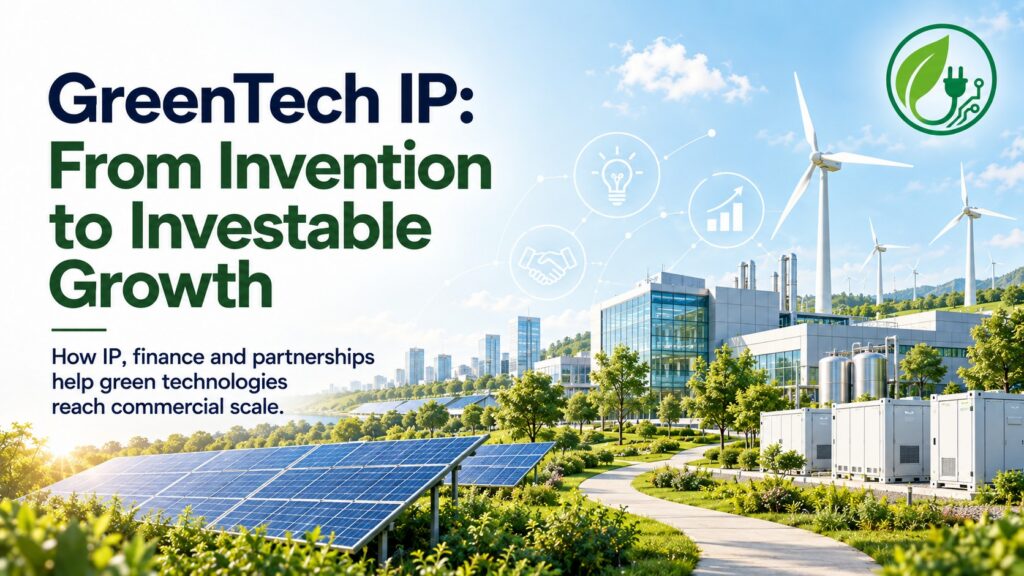
GreenTech IP and the journey from invention to investable growth
A GreenTech invention may solve a genuine technical problem and still be difficult to finance or scale. As Andrew Cockerell sais investors and industrial partners need to understand not simply that a technology is protected, but how that protection supports a commercially repeatable business.
|
This article examines the transition from invention toward investment and deployment. It connects patent strategy with application choice, customer adoption, geographical protection, system economics and partnership design.
|
One of its central points is that investment readiness depends on a credible answer to a broader question: How much of the value created through successful deployment can the innovator actually retain?
|
|
That may depend on patents, but also on confidential process knowledge, access to operating data, improvement rights and the ability to reuse learning from one partnership in future projects.
|
|
|
The article bridges IP strategy and investment logic. It is particularly useful for understanding why ownership alone is not enough: investors need to see how technical advantage, partner access, market adoption and value capture will continue to work as the company grows.
|
|
|
|
|
|
|
|
|
|
IP in Business Ecosystems
Companies increasingly create value inside networks they do not fully own.
|
Robotics businesses depend on suppliers, software platforms and integrators. MedTech companies combine technology, clinical infrastructure, data and external healthcare systems. Photonics companies operate across foundries, packaging specialists, equipment suppliers, standards and customers.
|
This 🧭 dIPlex Deep Dive examines the IP consequences of that reality. Instead of asking only which rights a company owns, it asks where the company has control, where it depends on others and how IP influences its bargaining position inside the ecosystem.
|
|
A particularly useful idea is to look at interfaces as control points. APIs, data flows, technical standards, software integrations, development agreements and access rights determine who may connect, build, learn and commercialise.
|
|
|
|
|
Read more on the digital IP lexicon 🧭dIPlex
|
|
|
|
|
The Deep Dive therefore fits closely with this issue: each of the three NEWS stories involves a business moving beyond the boundaries of an isolated technology and becoming increasingly dependent on a larger value architecture.
|
|
|
|
|
Visible Council - the IP Expert Branding Column
|
|
|
Strategic Visibility for IP Professionals Who Prefer Depth Over Exposure
|
|
by columnist Giulia Donato, Branding & Communication Consultant at people and brand strategies
|
|
|
|
|
For many IP professionals, visibility can feel uncomfortable because it is often associated with constant posting and personal exposure.
|
Giulia Donato argues for a different approach: strategic visibility is not about being seen everywhere, but about being recognised for the right expertise in the right situations.
|
For experts who prefer depth over frequency, this means focusing on a limited number of topics where their perspective is genuinely distinctive and useful. In an environment where AI makes content increasingly easy to produce, thoughtful selection and a consistent point of view can become stronger signals than sheer publishing volume.
|
|
The practical question is therefore not “How can I be more visible?” but “What should people remember me for?”
|
|
|
|
|
|
|
|
|
|
|
|
My Favorite from the 📝IP Business Academy Blog
|
Scaling Proprietary Technology: How IP Management Shapes the Next Stage of Growth
|
|
|
|
A proprietary technology can become most vulnerable at exactly the moment when commercial success begins. As deployment expands, partners need engineering documents, operating parameters, implementation support and access to technical knowledge. Individual projects generate improvements and new operating experience. Gradually, more of the capability required to reproduce the technology leaves the original development team.
|
|
The article argues that this transition should be actively designed.
|
A scalable technology business rarely consists of patents alone. Its competitive position can combine formal rights, confidential know-how, engineering documentation, operating experience and specialist capabilities developed through repeated implementation.
|
The management task is therefore to decide deliberately what partners need in order to succeed - while preserving the company’s ability to learn from each project and apply that learning elsewhere.
|
This includes questions about access to improvements, reuse of project knowledge, partner qualification, engineering packages and the division between technology licensing and continuing specialist services. The practical lesson for IP managers is that technology transfer should be designed as a repeatable capability rather than handled as a sequence of individual disclosure decisions. The objective is not to minimise knowledge transfer. Growth depends on transfer.
|
The objective is to make sure that each deployment helps the customer succeed without gradually transferring away the capability that makes future deployments valuable to the technology owner.
|
|
|
|
|
|
|
|
|